The Pharaoh's Floating Resort: Ancient Egypt's All-Inclusive Cruises and the Vacation That Never Changes
The Pharaoh's Floating Resort: Ancient Egypt's All-Inclusive Cruises and the Vacation That Never Changes
Somewhere in the Egyptian collection of the British Museum, there are papyri that describe, in careful administrative detail, the provisioning of pleasure vessels on the Nile. Wine allocations. Musicians' contracts. Lists of stops at temples that had been on every wealthy traveler's itinerary for generations. Reading them, one experiences a faint but unmistakable sense of recognition — not of ancient Egypt specifically, but of a brochure. The language of curated experience, of managed delight, of a journey in which every variable has been anticipated and addressed, is the same language that fills the websites of all-inclusive resorts from Cancún to the Maldives.
This resemblance is not coincidental. It reflects a consistent human impulse: the desire to obtain the status and the feeling of having traveled without accepting the actual conditions of travel. Ancient Egypt's Nile cruise industry — and it was an industry, documented across centuries of papyri, temple inscriptions, and Greek travel accounts — was the earliest large-scale attempt to satisfy that impulse. What those documents reveal about whether the attempt succeeded is something every traveler considering a week at an all-inclusive property might find worth reading.
What the Nile Circuit Actually Looked Like
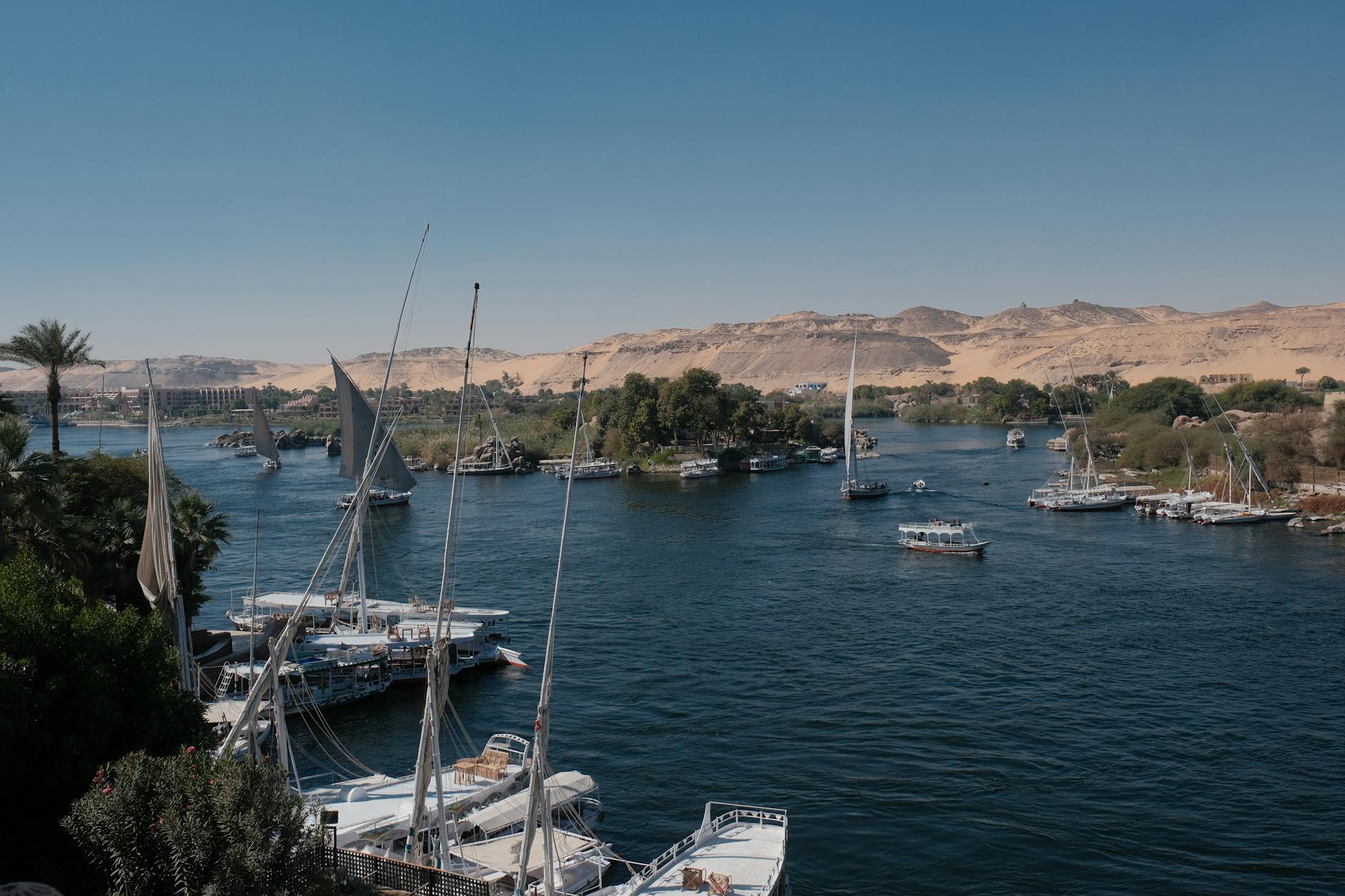
By the New Kingdom period, a recognizable luxury travel circuit had developed along the Nile, running from the Delta south toward Thebes and, for the more ambitious, continuing to Aswan and the monuments of Nubia. The infrastructure supporting this circuit was substantial. Specialized vessels — broader, more stable, and considerably better appointed than working river craft — carried wealthy passengers and their households. Stops were coordinated with temple administrators who had long experience receiving distinguished visitors and knew precisely what those visitors expected to see.
The Greek geographer Strabo, who traveled Egypt around 25 BC and wrote about it with the systematic attention he brought to everything, described a Nile journey that reads like a package tour. Specific temples. Specific priests who explained specific things. Specific local specialties offered at specific points along the route. Strabo was clearly following a well-established path, and he was clearly aware that he was following it — his account has the slightly dutiful quality of a traveler checking items off a list that others had compiled.
The papyri from Oxyrhynchus and other sites add the domestic detail that formal travel accounts omit. Wealthy travelers brought their own cooks, their own bedding, their own entertainment. Some brought household shrines. The goal, evident in the provisioning lists, was to ensure that the Nile journey reproduced the conditions of home as closely as the river permitted. The scenery would be different. Everything else would be familiar.
The Entertainment Apparatus
One of the more striking features of documented Nile pleasure cruises is the sophistication of their entertainment programming. Musicians, dancers, and storytellers were standard provisions on vessels of any ambition. The Harris Papyrus, among other sources, references the organization of performance aboard royal and noble river craft. Banquets were staged with the same ceremonial attention given to those on land.
This is recognizable. The all-inclusive resort's essential promise — that you will never encounter an unplanned moment, that every hour can be filled with organized activity if you choose, that boredom is an administrative failure rather than a natural condition — is precisely what the Nile cruise industry was delivering to Egypt's wealthy class. The specific entertainments have changed. The function has not.
What the papyri also reveal, in their gaps and their complaints, is that this apparatus sometimes produced its intended effect and sometimes produced something else: a vague restlessness, a sense of having been processed through an experience rather than having had one. The Greek traveler Aelius Aristides, who traveled extensively in Egypt in the second century AD and left detailed accounts of his experiences, described the Nile journey in terms that suggest ambivalence — impressed by the monuments, oddly unmoved by the journey itself, uncertain what he had actually encountered.
The Gap Between Seeking and Finding
The most useful question the ancient Nile cruise record raises is not whether wealthy Egyptian and Greek travelers enjoyed themselves. By most accounts, they did. The question is whether they found what they were looking for — and the evidence suggests that many of them were not entirely sure what that was.
Strabo wanted knowledge, and the Nile circuit gave him information. He cataloged what he saw with impressive thoroughness. But his account of Egypt has a quality of accumulation rather than revelation — he gathered facts about a civilization that he acknowledged was far older than his own framework for understanding it, and he came away with a very organized collection of data and something short of comprehension.
The wealthy Egyptian travelers documented in New Kingdom sources were seeking, among other things, proximity to the sacred — the great temples of the south, the tombs of the ancestors, the sites where the gods had been present in ways the Delta cities could not replicate. What the curated cruise offered them was access to these sites within a controlled environment that minimized the disorientation such encounters might otherwise produce. The temples were visited. The priests explained. The vessel moved on. The sacred was, in some meaningful sense, managed.
This is the structural problem with any travel product designed to eliminate friction. Genuine transformation — the kind that pilgrims across every tradition have sought and occasionally found — requires the traveler to be vulnerable to the experience. A journey in which every discomfort has been anticipated and neutralized, in which the unfamiliar has been pre-digested into the familiar, in which the destination is essentially an extension of the domestic environment carried to a more scenic location, is a journey that has been optimized against the conditions under which transformation typically occurs.
What the Ancient Record Suggests About Modern Choices
None of this is an argument against comfort, or against the legitimate appeal of a week at a well-run resort. Rest is a real human need, and there is nothing dishonest about pursuing it. The ancient Nile cruise offered genuine pleasure to many of its passengers, and the all-inclusive resort does the same.
The argument is about alignment between expectation and structure. Travelers who board a Nile cruise — ancient or modern — expecting to encounter Egypt on its own terms are likely to find that the product is not designed for that encounter. Travelers who board expecting a comfortable, well-organized experience in a spectacular setting will probably be satisfied. The mismatch between those two expectations and that one product has been generating the same low-grade disappointment for roughly three thousand years.
The papyri do not lie. The wealthy travelers who provisioned their Nile vessels with everything from home were not seeking transformation. They were seeking a particular quality of leisure, and they got it. The Greek intellectuals who traveled the same river looking for the deep Egypt behind the curated surface generally found the experience somewhat less than they had hoped.
Before booking the all-inclusive, it is worth asking — with the honesty that the ancient record demands — which traveler you actually are. The Nile has seen both, and it has not been fooled by either.