The Architecture of Overwhelm: Why Every Civilization Builds an Exit Door
The Universal Design Problem
In 1845, Henry David Thoreau walked into the Massachusetts woods carrying an axe and a borrowed book on architecture. What he built at Walden Pond wasn't revolutionary—it was archetypal. The 10-by-15-foot cabin represented humanity's oldest solution to a recurring crisis: when civilization overwhelms the individual psyche, the species responds by creating deliberate spaces of retreat.
Thoreau didn't invent this impulse. He inherited it from a design tradition stretching back to the first cities that grew too large for human comprehension. Every civilization that has reached sufficient complexity has faced the same engineering challenge: how to build spaces that absorb psychological overload before it breaks the people who make the system function.
The pattern is so consistent across cultures and centuries that it suggests something fundamental about human neurological architecture. We are not designed for continuous stimulation. When societies grow complex enough to provide it anyway, they must also provide structured relief.
The Japanese Solution: Engineered Solitude
Japanese culture formalized this understanding into komorebi—the interplay of light filtering through forest leaves. But komorebi spaces weren't accidental discoveries. They were deliberately constructed environments designed to regulate nervous system arousal through specific visual and auditory inputs.
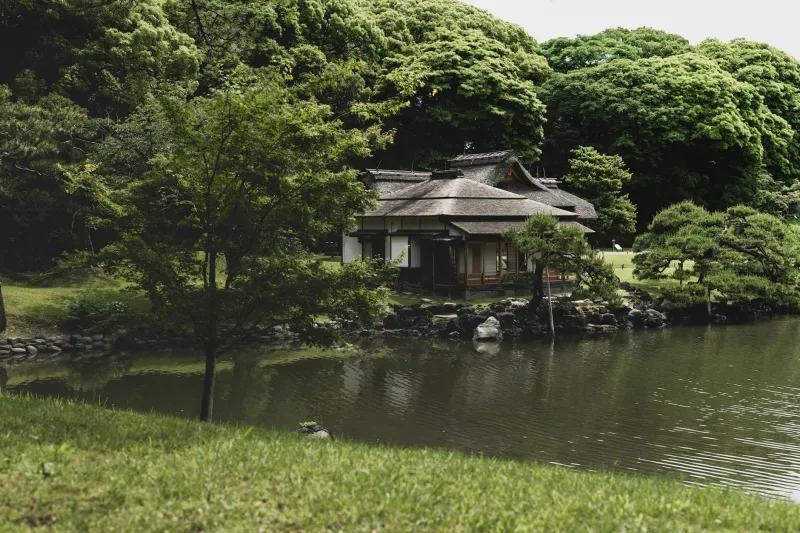
Traditional Japanese gardens represent four centuries of psychological engineering. The placement of stones, the angle of pathways, the selection of plants—every element was calibrated to induce what modern neuroscience calls parasympathetic activation. The tea house positioned at the garden's heart wasn't decoration. It was the functional core: a space small enough to feel contained, isolated enough to feel separate, yet connected enough to avoid claustrophobia.
American visitors to these spaces often describe them as "peaceful" or "calming." They're responding to design principles that predate their cultural context by centuries. The Japanese didn't build beautiful gardens. They built therapeutic architecture disguised as aesthetic experience.
The Islamic Innovation: Sanctuary Within Structure
Medieval Islamic courts faced a different version of the same problem. Urban centers like Baghdad, Cordoba, and Cairo grew into cosmopolitan hubs managing trade routes spanning three continents. The psychological pressure of governing diverse populations while maintaining cultural identity demanded architectural solutions.
The answer was the enclosed garden—the paradise courtyard that appeared at the center of every significant Islamic building from Spain to Central Asia. These weren't decorative spaces. They were psychological pressure valves: walled environments that provided sensory relief while maintaining the social structures that made complex urban life possible.
Water features weren't aesthetic choices but neurological interventions. The sound of flowing water masks urban noise while providing the auditory consistency that allows mental reset. The geometric patterns in tilework weren't artistic expression but visual meditation aids—repetitive designs that occupy the conscious mind while deeper psychological processes recalibrate.
Modern Americans visiting the Alhambra or the Alcázar of Seville often report feeling "transported" or "removed from time." They're experiencing the intended effect of architecture designed to temporarily separate consciousness from environmental pressure.
The American Transcendentalist Laboratory
The 19th-century American Transcendentalist movement represented the New World's first systematic attempt to solve the retreat problem. Unlike older civilizations with established architectural traditions, Americans had to engineer solutions from scratch.
Thoreau's Walden experiment wasn't romantic escapism but practical research. He was testing whether deliberate simplification of environment could produce reliable psychological effects. His detailed records show someone conducting empirical investigation: measuring the relationship between physical isolation and mental clarity, documenting how reduced sensory input affected creative output.
The Transcendentalists' innovation was making retreat temporary and intentional rather than permanent and necessary. They transformed the sanctuary from institutional architecture into personal practice. This shift anticipated modern wellness culture by 150 years.
The Pattern Recognition
Across these diverse cultural solutions, certain design principles repeat with mathematical consistency:
Controlled Scale: Effective retreat spaces are always smaller than the environments they provide relief from. The human nervous system requires spatial containment to achieve psychological reset.
Sensory Simplification: Whether through Japanese stone gardens, Islamic geometric patterns, or Thoreau's bare cabin walls, successful retreat architecture reduces rather than amplifies sensory input.
Natural Elements: Water, plants, natural light, and organic materials appear in every tradition. This isn't aesthetic preference but neurological requirement.
Controlled Access: All effective retreat spaces have clear boundaries—walls, gates, thresholds that mark transition from stimulating to calming environment.
The Modern Application
Today's wellness resort boom represents the latest iteration of this four-thousand-year design tradition. But understanding the historical pattern reveals which contemporary spaces will actually provide the intended psychological effects versus which are simply marketing lifestyle aspiration.
The most effective modern retreat destinations unconsciously reproduce the architectural principles that medieval Islamic courts, Japanese gardens, and Transcendentalist cabins shared in common. They provide spatial containment, sensory simplification, natural elements, and controlled access.
When choosing where to go when the world becomes too much, look for spaces that solve the same design problem humans have been working on since the first cities grew too large for individual comprehension. The architecture of overwhelm hasn't changed. Neither has its antidote.
The Structural Necessity
This pattern suggests that retreat spaces aren't luxury amenities but structural requirements for complex societies. Civilizations that fail to provide psychological pressure valves don't maintain stability. The Romans built baths, the Japanese built gardens, the Islamic courts built paradise courtyards, and Americans built national parks.
Each represents the same solution to the same problem: when human systems grow beyond individual cognitive capacity, they must also provide spaces for individual psychological maintenance. The panic room has always existed because it has always been necessary.