The Territory Is Not the Menu
Every disappointment you've ever experienced while traveling began with a map. Not necessarily the kind that hangs on walls or loads on your phone, but the broader category of representation that includes brochures, websites, Instagram feeds, and guidebook descriptions. These are all maps in the deepest sense—selective representations of reality designed to guide behavior.
The gap between map and territory isn't an accident or oversight. It's the fundamental business model of the travel industry, refined over two millennia of practice. Understanding this gap, and learning to read the intentions behind every map you encounter, transforms you from a disappointed tourist into an informed traveler.
Roman Roads to Nowhere
The Romans invented modern cartographic propaganda. Their famous road maps, carved in stone and bronze throughout the empire, weren't primarily navigation tools—they were political statements. The Peutinger Table, a 13th-century copy of a Roman original, stretches the Mediterranean into an impossible ribbon to emphasize Rome's central position.
These maps systematically distorted geography to serve imperial messaging. Distance was measured not in miles but in days of travel from Rome. Barbarian territories appeared as blank voids. Roman cities were depicted as elaborate architectural gems, while equally significant foreign settlements merited single dots.
The psychological impact was profound. Citizens navigating by these maps experienced the empire as Romans wanted them to: vast, well-ordered, and radiating outward from an obviously superior center. The maps didn't just describe Roman territory—they created Roman identity.
Medieval Mappamundi: Theology as Geography
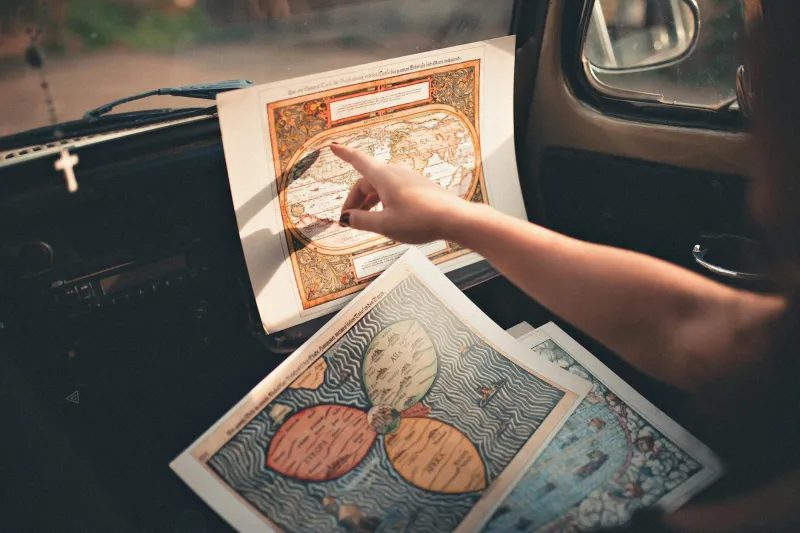
Medieval European maps reveal even more dramatic departures from geographical accuracy in service of ideological goals. The famous Hereford Mappa Mundi places Jerusalem at the world's center, with Europe, Asia, and Africa arranged in perfect theological symmetry around it.
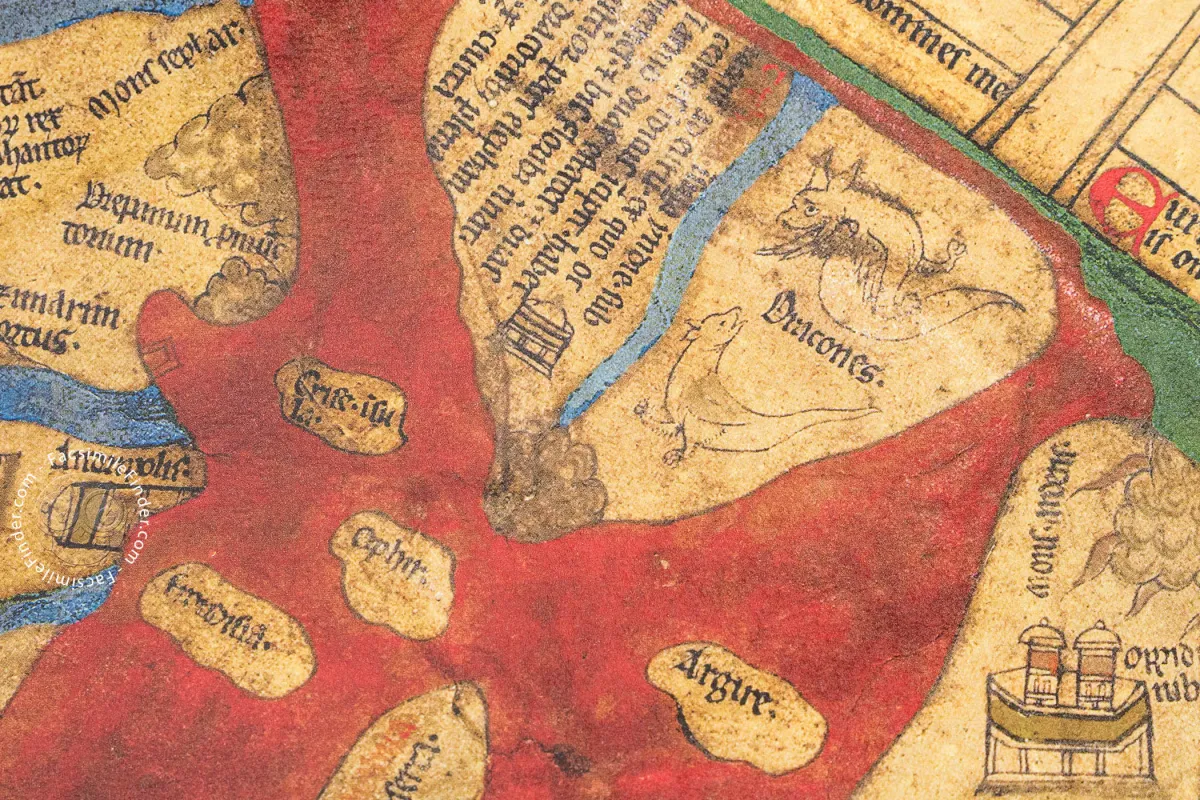 Photo: Hereford Mappa Mundi, via ff-65a4.kxcdn.com
These weren't primitive attempts at scientific cartography—they were sophisticated visual arguments about cosmic order. Paradise appears as a literal location in the Far East. Monstrous races populate the margins. Biblical events are mapped onto geographical space with the precision of a lawyer citing precedent.
Pilgrims navigating by such maps weren't just traveling to destinations—they were moving through a sacred narrative. The journey became meaningful not because of where they ended up, but because of the story the map told about why that destination mattered.
The Tourism Board Revolution
Modern destination marketing represents the most sophisticated evolution of cartographic manipulation ever developed. Tourism boards don't just omit inconvenient realities—they actively construct alternative geographies designed to trigger specific emotional responses.
Consider how tourism maps handle poverty, industrial development, and social problems. A typical destination brochure might show a city center that occupies two square miles, while completely omitting the surrounding forty square miles where actual residents live and work. The resulting map creates a clean, contained experience that bears little resemblance to the complex reality of the place.
This isn't necessarily malicious—it's strategic. Tourism boards understand that travelers aren't seeking authentic experience as much as they're seeking escape from complexity. The map that accurately represents a destination's full reality would be a poor marketing tool.
Digital Distortion: The Algorithm's View
Smartphone mapping applications represent the newest frontier in selective representation. These tools appear neutral—they're just showing you "what's there." But every digital map is the product of countless editorial decisions about what deserves inclusion, how locations should be categorized, and which routes deserve recommendation.
Google Maps, for instance, doesn't just reflect geography—it actively shapes it. Businesses that optimize for local search appear more prominently. Neighborhoods with better internet infrastructure get more detailed representation. Areas where Google has commercial partnerships receive enhanced coverage.
The result is a feedback loop where digital maps don't just describe places—they determine which places thrive and which disappear from practical existence. The restaurant that doesn't appear on mapping apps might as well not exist for most travelers.
The Psychology of Selective Seeing
Why do these distorted maps work so effectively? Because human psychology craves simplified narratives over complex realities. When you're planning travel, your brain is already in fantasy mode—you want to believe in the perfect destination, the seamless experience, the transformative journey.
Cartographic propaganda succeeds because it aligns with existing psychological biases. We want to believe that somewhere else is better than here, that travel will solve problems that staying home won't, that the perfect place exists and can be reached by following the right directions.
This isn't a character flaw—it's a survival adaptation. Throughout human history, the ability to envision better circumstances elsewhere has driven exploration, migration, and innovation. Maps that promise improvement tap into this deep evolutionary programming.
Reading Between the Projections
Developing map literacy means learning to ask three questions about every representation you encounter: Who created this? What do they want me to do? What aren't they showing me?
A tourism board map wants you to visit and spend money, so it emphasizes attractions while omitting difficulties. A real estate development map wants you to buy property, so it exaggerates proximity to desirable amenities while downplaying inconvenient realities like traffic or noise.
Even seemingly neutral sources have agendas. Guidebook maps reflect their publishers' commercial relationships and target demographics. Social media location tags represent the aesthetic preferences of their most active users, not the full reality of places.
The Honest Traveler's Toolkit
Effective modern travel requires developing resistance to cartographic seduction while maintaining openness to genuine discovery. This means consulting multiple sources, seeking out dissenting voices, and accepting that no single representation can capture a place's full reality.
The most useful maps are often the most boring: topographical surveys, demographic data, infrastructure reports, crime statistics, climate records. These unglamorous sources provide the foundation that allows you to evaluate more exciting promotional materials with appropriate skepticism.
Embracing Productive Disillusionment
The goal isn't to become cynical about all travel representation—it's to develop sophisticated expectations. Understanding that every map is propaganda allows you to engage with destinations more thoughtfully and arrive with more realistic frameworks for evaluation.
When you know that the tourism board map omitted the industrial district, you're not disappointed to discover it. When you understand that the Instagram location tag represents one carefully curated angle, you're prepared to appreciate the full three-dimensional reality.
The travelers who report the highest satisfaction aren't those who found perfect destinations—they're those who arrived with clear understanding of the gap between representation and reality. They used maps as starting points for exploration rather than scripts for experience.
The Territory Remains
Despite centuries of cartographic manipulation, the underlying territory persists in all its complexity. Cities contain both beauty and ugliness, history includes both triumph and tragedy, cultures encompass both welcome and rejection. The map that acknowledges this complexity may be less seductive, but it prepares you for more authentic engagement with the world as it actually exists.
The ultimate cartographic wisdom is this: every map lies, but some lies are more useful than others. Learning to identify the useful lies while maintaining awareness of their limitations is the foundation of intelligent travel in an age of infinite representation.