Following the Same Roads: What Americans Inherit When They Retrace a Family Journey
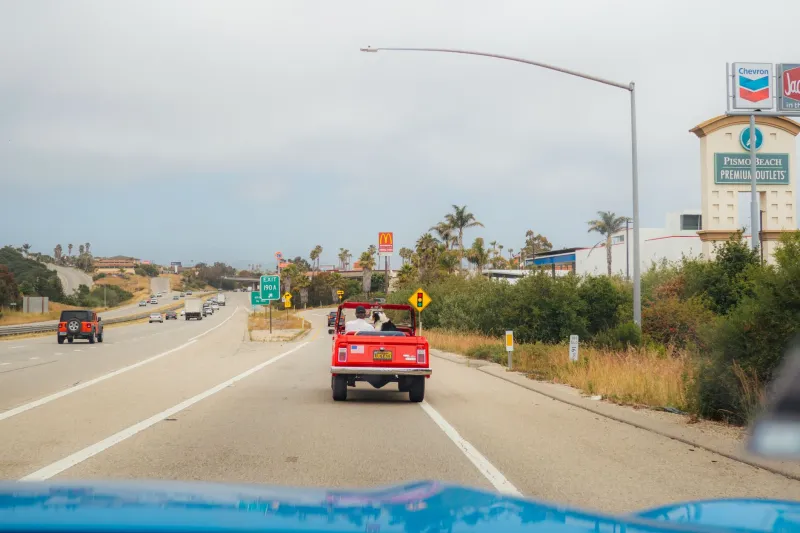
The photograph exists in nearly every American family archive. A car—a Buick, perhaps, or a Ford station wagon—parked in front of something recognizable: Old Faithful, the Washington Monument, a roadside attraction whose sign has since been repainted or removed. The people standing beside it are younger versions of people now gone, or older versions of people still living, squinting into a summer sun from a decade that can be dated by the cut of the clothing. Someone in the current generation looks at this photograph and thinks: I want to go there.
Not to the landmark. To the moment. And since the moment is inaccessible, they go to the road.
The Literalization of Inheritance
American culture has always struggled with abstract inheritance. The transmission of values, temperament, and identity across generations is invisible and unverifiable—you cannot stand in the spot where your grandmother's courage was formed and confirm that you are standing correctly. Physical inheritance, by contrast, is legible. A house, a piece of furniture, a road traveled: these are things that can be located, visited, and measured.
This is why the family trip retrace has become a recognizable American phenomenon. It is not nostalgia in any simple sense. It is an attempt to make the intangible concrete—to convert an inherited identity into a sequence of navigable coordinates. If your parents drove Route 66 in 1962, then Route 66 in 1962 is part of what made them the people who made you. To drive it now is to stand inside the source material.
The impulse is not new. Roman aristocrats retraced the routes of famous ancestors as acts of both piety and self-definition. Medieval pilgrims followed established paths not merely for religious reasons but because walking the same road as a revered predecessor was understood to create a form of proximity to that person's experience. In seventeenth-century Japan, the poet Matsuo Bashō traveled explicitly to visit sites associated with earlier poets, understanding that the geography of someone's life was a form of access to that life.
The American road trip retrace is the democratic, automobile-era version of the same practice.
What the Route Knows That the Story Doesn't
Family stories are edited. They compress time, emphasize resolution, and omit the texture of experience—the boredom of the long afternoon drive, the argument at the motel check-in, the meal that was disappointing and has never been mentioned since. The route does not edit. It presents itself at the same scale it always did: the same distance between cities, the same topographical transitions, the same quality of light at the same hour.
Travelers who retrace family journeys frequently report that the experience corrects the inherited narrative in ways they did not anticipate. A drive that family legend described as straightforward turns out to be genuinely arduous. A destination remembered as magnificent turns out to be modest. A stretch of highway recalled as desolate has been absorbed into suburban sprawl. The road offers information that the story withheld, either because it seemed unimportant or because it was quietly suppressed.
This corrective function is one of the most historically consistent features of travel as a mode of inquiry. Herodotus noted that direct observation consistently revised what he had been told. The great American travel writers of the twentieth century—Steinbeck, Least Heat-Moon, Bryson—built entire careers on the gap between expectation and landscape. The family retrace traveler is conducting the same investigation at a personal scale: testing the story against the territory.
Migration Routes and the Deeper Inheritance
For a significant portion of American travelers, the retrace extends beyond vacation memory into something more fundamental: the original journey that brought a family to where it now stands. These migration routes—from Ellis Island to a particular neighborhood in Pittsburgh, from a Mississippi county to a Chicago address, from a Mexican border crossing to a California agricultural town—carry a different weight than the recreational road trip.
To travel a migration route is to engage with a decision that determined everything subsequent. The ancestor who made that journey chose, under conditions of varying duress, to move from one world to another. The descendant who retraces it is attempting to understand what that choice felt like—what was left behind, what was hoped for, what the landscape looked like to someone who had never seen it before and had no guarantee of what came next.
Genealogical tourism has grown substantially in the United States over the past two decades, driven partly by the democratization of ancestry research through digital archives and DNA testing. What these tools provide is names and dates. What the road provides is something else: the physical experience of the distance itself, the sense of how far away the origin actually was, the particular quality of the landscape that greeted an ancestor upon arrival.
Several historians of American migration have noted that descendants who make these journeys consistently report a recalibration of their understanding of their family's history—not because they discover new facts, but because they experience, in attenuated form, the physical reality of a journey that had previously existed only as an abstraction.
The Gap Between Their Road and Yours
There is, of course, an irreducible problem with the retrace. The road has changed. The motels your grandparents stayed in are gone, or converted, or operating under different management with different rates and different clientele. The diner is a chain restaurant or a vacant lot. The gas station is a convenience store. The landscape has been altered by half a century of development, erosion, and rerouting.
This gap is not an obstacle to the retrace. It is its central subject.
The distance between the road as it was and the road as it is now is a precise measurement of time—not abstract time, but the specific time that elapsed between your grandparents' journey and yours. To drive a route that has changed is to experience change directly, to understand that the world your family moved through no longer exists except in photographs and memory, and that your own journey will one day be equally historical to someone who comes after you.
This is, ultimately, what the family retrace offers that no other form of travel research can provide: not information about the past, but a physical encounter with the fact of its passing. The road teaches what the archive cannot—that inheritance is always a conversation with something irretrievably gone, and that the value of the conversation lies not in recovering what was lost but in understanding, more precisely, what it means to have lost it.