Before the Algorithm: What Medieval Pilgrims Knew About Getting There That Your Travel App Does Not
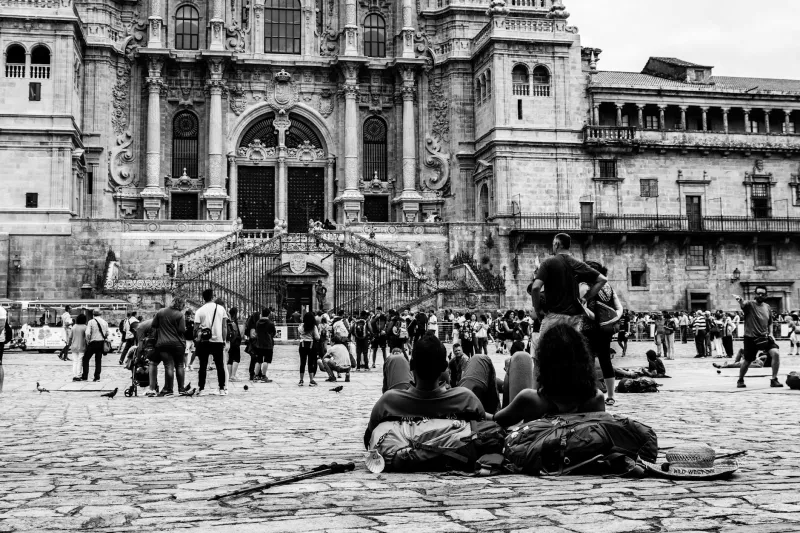
Before the Algorithm: What Medieval Pilgrims Knew About Getting There That Your Travel App Does Not
At some point in the twelfth century, an unknown cleric sat down and wrote what may be the most practically useful travel document in the Western tradition. The Codex Calixtinus, a manuscript associated with the pilgrimage route to Santiago de Compostela in northwestern Spain, contains, alongside its liturgical content, a guide to the road itself — its towns, its rivers, its hospices, and its hazards. Book Five of the Codex, known as the Liber Sancti Jacobi, describes in specific and unsentimental terms which rivers are safe to drink from, which are not, which innkeepers are honest, which ferrymen have been known to drown pilgrims for their belongings, and which stretches of road are best navigated in company rather than alone.
This is, by any reasonable definition, a travel guide. It is also, in several important respects, a better travel guide than what your phone currently offers.
The Itinerarium and What It Actually Did
The medieval itinerarium — a Latin term covering everything from simple route lists to elaborate narrative guides — was a practical genre born of genuine need. Pilgrimage in the medieval period was not a spiritual metaphor. It was a physical undertaking that killed people with some regularity, through disease, violence, exposure, and the straightforward misfortune of drinking from the wrong stream at the wrong moment. The guides that circulated among pilgrim communities were written by people who had survived the road and were attempting to transmit that survival to others.
What distinguished the best of these documents was their specificity. The Codex Calixtinus does not describe the Camino de Santiago in the impressionistic language of a modern travel blog. It names rivers. It names towns. It names the specific populations of those towns and characterizes their hospitality or lack thereof with a directness that would make a contemporary review platform nervous. The Basques, the author notes with considerable diplomatic bluntness, are not to be trusted on the question of ferry pricing. The people of certain Navarrese towns are described in terms that suggest the author had a very bad afternoon there.
This granularity was not incidental. It was the entire point. A pilgrim consulting the guide needed to know not that a region was generally hospitable but that the hospice in a specific town was run by a specific order that could be relied upon, while the inn three streets away was operated by a man of flexible ethics.
The Information Problem That Never Changed
Modern travel applications have solved, with impressive thoroughness, the problem of knowing where things are. Mapping technology that would have seemed miraculous to a twelfth-century pilgrim is now standard on every American smartphone. You can know, to within a few meters, exactly where you are standing and exactly how far you are from the nearest restaurant, hotel, pharmacy, or petrol station.
What the apps have not solved — and what the medieval guides addressed with more sophistication than is generally acknowledged — is the problem of knowing what things are worth. The aggregated star rating is the modern equivalent of the itinerarium's hospice assessment, and it suffers from the same limitation that plagues all democratic consensus mechanisms: it is excellent at identifying the broadly acceptable and nearly useless at identifying the genuinely excellent or the specifically dangerous.
The Codex Calixtinus knew that a pilgrim arriving exhausted at a river crossing did not need to know that the ferry service was generally satisfactory. She needed to know whether this particular ferryman, on this particular stretch of river, had a documented history of overcharging foreigners. The specificity of the warning was inseparable from its usefulness.
Current review platforms aggregate that specificity out of existence. A ferry operator with three hundred four-star reviews and one documented incident of predatory pricing toward foreign travelers appears, to the algorithm, as a four-star ferry operator. The medieval guide would have flagged the incident. The app buries it.
The Pilgrim's Mindset as a Corrective Technology
But the more durable lesson from the itinerarium tradition is not methodological. It is philosophical.
The medieval pilgrim did not travel to optimize. She traveled to arrive — and she understood that the difficulty of arrival was not a flaw in the journey but its essential mechanism. The hardship of the Camino, the physical and logistical demands of crossing the Pyrenees or navigating the long plateau of the Meseta, was not incidental to the pilgrimage's spiritual value. It was constitutive of it. The person who reached Santiago de Compostela after six weeks of walking was not the same person who had left Saint-Jean-Pied-de-Port, and the transformation was inseparable from the difficulty.
This is not a romantic notion. It is a psychological observation that has been confirmed, in various forms, by research on how humans assign meaning to experiences. Effort, discomfort, and the necessity of solving genuine problems in real time produce memories and attachments that passive consumption does not. The traveler who spent three hours lost in a city, was rescued by a stranger, and ended up eating dinner at a table that no algorithm would ever have recommended has a story. The traveler who followed the optimized route to the top-rated restaurant has a photograph.
The itinerarium tradition understood this implicitly. The guides did not attempt to remove difficulty from the pilgrimage. They attempted to distinguish between productive difficulty — the kind that transforms you — and gratuitous hazard, the kind that merely kills you. Drink from the named safe rivers. Avoid the named dishonest ferrymen. Everything else is the road, and the road is the point.
What to Take From the Tradition
For the contemporary American traveler, the medieval itinerarium offers a practical reorientation rather than a nostalgic model. You should absolutely use the mapping application. You should probably consult the aggregated reviews. But you should consult them the way a twelfth-century pilgrim consulted her route guide: as a baseline of survival information, not as a substitute for judgment.
The guide tells you which rivers are safe. It does not tell you which rivers are worth sitting beside for an hour before you cross them. That determination belongs to you, and it requires the kind of attention that optimization actively discourages.
The pilgrims who reached Santiago de Compostela and wrote the guides that helped the next generation reach it understood something that the modern travel industry has a structural interest in obscuring: the journey is not a problem to be solved. It is the thing itself. The app can tell you where you are. Only the road can tell you who you are becoming.