Premium Romance: How America's Hotels Trained Us to Buy Love by the Night
Premium Romance: How America's Hotels Trained Us to Buy Love by the Night
In 1847, a young couple from Boston spent their wedding night in a tavern room they shared with three other travelers. The bride wrote to her sister that the accommodations were "perfectly adequate for our purposes," and made no mention of rose petals, champagne service, or heart-shaped anything. She couldn't have imagined that within a century, her great-granddaughter would feel cheated without a dedicated honeymoon suite costing more than a month's wages.
The transformation wasn't gradual. It was engineered.
The Invention of the Special Room
Before the Civil War, American hospitality operated on a fundamentally different premise: shelter was shelter. The best hotels offered clean sheets and decent food, but the idea that different life events required different categories of accommodation would have seemed absurd. Newlyweds, traveling merchants, and circuit judges all slept in the same rooms, paid similar rates, and expected nothing more than basic comfort.
The shift began in the 1870s, when America's first generation of purpose-built resort hotels started segmenting their inventory. The Grand Hotel on Mackinac Island, opened in 1887, was among the first to market specific rooms for "bridal parties" — not because honeymooners demanded special treatment, but because hotel operators discovered they could charge premium rates for the same square footage by adding a few theatrical touches.
The psychology was brilliant in its simplicity. By creating a category of "special" accommodations, hotels didn't just capture more revenue per room; they established the principle that milestone moments required milestone spending. The suite didn't follow the demand — it manufactured it.
The Gilded Age Laboratory
America's resort boom of the 1880s and 1890s served as a testing ground for what would become the modern hospitality industry's most profitable insight: people will pay exponentially more for the same product when it's packaged as emotionally significant. The Del Monte Hotel in California pioneered the "bridal chamber," complete with separate parlor and "enhanced appointments." The Greenbrier introduced tiered pricing based on life events rather than room size.
These weren't responses to customer complaints about inadequate honeymoon accommodations. Contemporary letters and diaries from the period show no evidence that newlyweds felt deprived by standard hotel rooms. Instead, hotel operators were applying the same segmentation strategies that railroads used for passenger classes — creating artificial scarcity and social pressure around what had previously been a commodity service.
The genius lay in the timing. America's emerging middle class was hungry for ways to demonstrate their prosperity and sophistication. The honeymoon suite provided a socially acceptable venue for conspicuous consumption while maintaining the fiction that the spending was about love rather than status.
The Postwar Acceleration
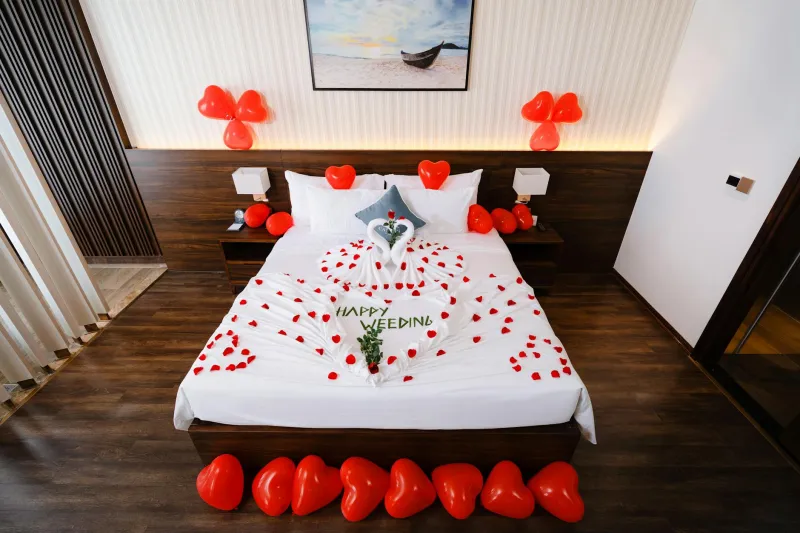
The concept might have remained a luxury market curiosity, but the postwar economic boom democratized the premium romance model. Chain hotels like Holiday Inn and Howard Johnson's discovered they could apply the same psychological principles at middle-class price points. By the 1960s, the "honeymoon package" had become a standard offering even at budget motels.
The standardization revealed the manufactured nature of the demand. When a roadside motor lodge in Ohio offered the same "romantic atmosphere" as the Plaza Hotel — champagne, flowers, and upgraded linens — it became clear that the experience was entirely constructed. The emotional significance wasn't inherent to the space; it was projected onto it through marketing and social expectation.
This democratization also accelerated the inflation of expectations. Each generation of hotels had to outdo the previous generation's definition of "special." Heart-shaped tubs gave way to in-room fireplaces, which gave way to private terraces and personal butler service. The baseline kept rising because the industry had trained customers to equate spending with caring.
The Psychological Architecture
The honeymoon suite operates on the same psychological principles that make people spend thousands on engagement rings or wedding dresses worn once. It transforms a practical transaction — needing a place to sleep — into an emotional one about demonstrating love and commitment. The higher price becomes proof of the deeper feeling.
This isn't unique to American culture, but American hospitality perfected the commercial application. European hotels of the same era focused on service quality and historical prestige. American hotels focused on emotional packaging and aspirational experience. They understood that their customers weren't just buying accommodation; they were buying permission to feel special.
The model works because it exploits a cognitive bias economists call "affect heuristic" — our tendency to judge value based on emotional associations rather than objective utility. A room that costs $500 per night feels more romantic than an identical room that costs $150, even when the only difference is marketing copy and a bottle of champagne.
The Modern Inheritance
Today's hospitality industry has extended the honeymoon suite model across every conceivable life event. Anniversary packages, babymoon suites, divorce celebration getaways — the segmentation never stops. Each category creates artificial demand for premium pricing on standard accommodations.
The pattern reveals something fundamental about how Americans learned to relate to milestone moments: we've been trained to believe that important experiences require expensive settings. The idea that a meaningful honeymoon could happen in a regular hotel room — as it did for centuries — now feels almost insulting to the significance of the occasion.
This training didn't happen naturally. It was the result of a century-long marketing campaign that convinced us to monetize our own emotional milestones. The honeymoon suite was always a lie, but it was a lie that taught us to lie to ourselves about what love requires.
The next time you find yourself comparing room packages for a special occasion, remember: your great-great-grandmother had just as meaningful a honeymoon in that shared tavern room. She just hadn't been taught to buy her feelings by the night.