Captive Audiences and Captive Wallets: What the Railroad Hotel Era Reveals About Modern Luxury Travel
Captive Audiences and Captive Wallets: What the Railroad Hotel Era Reveals About Modern Luxury Travel
There is a particular feeling that arrives when you have checked into a resort so complete, so comprehensively pleasant, that leaving it requires a kind of deliberate act of will. The pool is steps away. The restaurant is steps away. The spa, the bar, the curated gift shop stocked with things you did not know you needed — all of it is steps away. The outside world, by contrast, is inconvenient, unfamiliar, and probably expensive in ways you cannot predict. So you stay. You spend. You tell yourself this is relaxation.
American travelers in 1880 felt exactly the same thing, and they did not arrive at that feeling by accident.
The Machine That Built the Modern Tourist
When the transcontinental railroad opened the American West to civilian tourism, it created a logistical problem with an enormously profitable solution. Travelers from the East Coast were wealthy enough to afford the journey but entirely unprepared for the landscape they were crossing. The West was vast, the towns were sparse, and the existing accommodation was, by most surviving accounts, genuinely terrible — dusty, vermin-infested, and staffed by people who had not yet learned to regard the Eastern tourist as a resource worth cultivating.
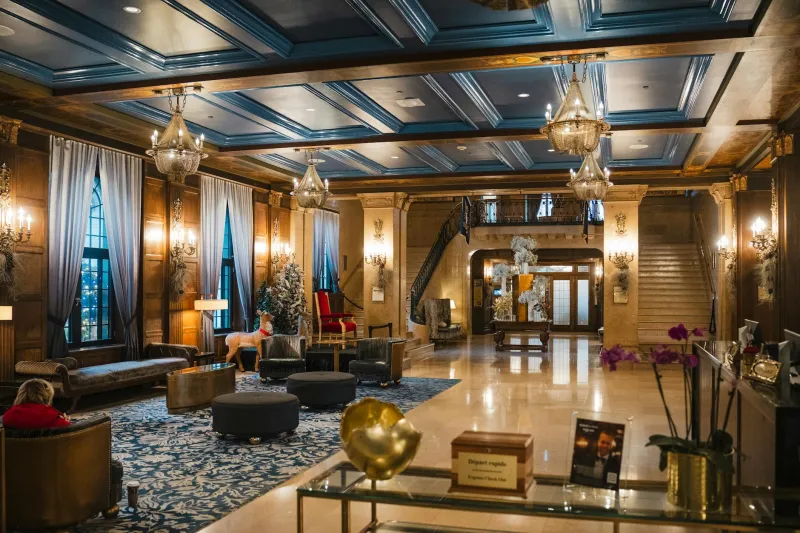
Fred Harvey understood this gap before almost anyone else. Beginning in 1876, Harvey partnered with the Atchison, Topeka and Santa Fe Railway to build a chain of hotels and dining rooms positioned at precise intervals along the rail line. The Harvey Houses were not merely comfortable — they were strategically, almost aggressively comfortable. White linen tablecloths. China dishes. Fresh food prepared by trained staff, including the famous Harvey Girls, whose professional demeanor was itself a selling point in a region where professional demeanor was a novelty.
The brilliance of the system was not the quality. It was the architecture of dependency. Travelers arrived tired, disoriented, and holding money they had budgeted for an undefined journey. Harvey's properties gave that money a very defined destination. Once a traveler was inside a Harvey House, every need was anticipated and every alternative was remote. The railroad schedule and the hotel's own rhythms synchronized to ensure that guests did not have time, energy, or incentive to look elsewhere.
This is not cynicism. It is engineering.
The Psychology of the Closed Loop
What Fred Harvey's organization understood — and what behavioral economists would spend the twentieth century laboriously documenting — is that human beings make dramatically different spending decisions when the transaction costs of alternatives are high. When leaving a property requires effort, when the outside world is opaque, when you have already committed to a place emotionally and financially, the marginal cost of one more purchase seems trivial compared to the friction of seeking a substitute.
The Harvey Company refined this insight into a complete economic ecosystem. Passengers on Santa Fe trains were encouraged to book Harvey accommodations in advance. The hotels were positioned so that layovers coincided with meal and rest periods. Souvenir shops — Harvey was among the first to systematically commercialize Native American crafts as tourist merchandise — captured spending that might otherwise have dispersed into local economies or simply not occurred.
The result was that a traveler who entered the Harvey system at Kansas City might not make a single unmediated economic decision until they reached Los Angeles. Every dollar spent felt like a choice. Almost none of it was.
Decay and the Pattern It Leaves Behind
The Harvey empire did not collapse because travelers grew wise to its methods. It collapsed because the automobile gave travelers the first genuine alternative in decades. Route 66, which the Santa Fe Railway had helped inspire, now ran parallel to the tracks and offered the intoxicating possibility of stopping anywhere, eating anywhere, sleeping wherever the road deposited you. The closed loop opened, and the money dispersed.
But the dispersal was temporary. The psychology that made the Harvey system work had not changed. The industry simply needed a new container for it.
The modern all-inclusive resort is that container. The bundled booking platform — which presents a hotel, flight, and rental car as a single transaction and makes unbundling them technically possible but psychologically exhausting — is that container. The airport terminal, which has evolved over the past thirty years from a waiting room into a retail environment designed to capture spending from people who have already passed through security and have nowhere else to go, is that container.
In each case, the mechanism is identical to what Harvey built in 1876: identify a moment when the traveler is disoriented, time-constrained, or emotionally committed, and make your product the path of least resistance.
What the Long Memory Tells You
Understanding this history does not require you to become a suspicious or joyless traveler. Harvey Houses were genuinely good. Many all-inclusive resorts are genuinely enjoyable. The bundled booking platform often saves you real money. The question the historical record poses is not whether these products have value but whether you are choosing them or being maneuvered into them.
The travelers who navigated the Harvey era most successfully were those who understood the system well enough to use it deliberately. They took the Harvey dining room when they were genuinely hungry and exhausted. They skipped it when they had the energy and curiosity to find something else. They bought the Navajo blanket because they wanted it, not because it was the only thing for sale within a hundred miles.
The collapse of the Harvey empire also offers a predictive template. Every closed-loop tourism economy in American history has eventually been disrupted by a technology or infrastructure change that restored genuine choice to travelers. The automobile broke the railroad hotel. The internet broke the travel agent's information monopoly. Whatever comes next — and something always comes next — will break the current bundling model by making alternatives visible and accessible in ways they presently are not.
The traveler who knows this history is positioned to wait for those moments of disruption and exploit them, rather than spending the interval between them paying a premium for the comfort of having no real options.
The past is not a warning. It is a map. And on this particular map, the closed loop always eventually opens.