The Threshold Never Crossed: On the American Habit of Visiting Places Without Entering Them
Every year, a dependable crowd assembles on the south bank of the Seine to photograph Notre-Dame Cathedral. A smaller but equally dependable crowd assembles outside the Louvre, photographs the glass pyramid, and departs without purchasing a ticket. At Versailles, visitors spend forty-five minutes in the garden photographing the palace facade before consulting their schedules and discovering, with what appears to be genuine relief, that they have a train to catch.
This behavior is so common as to have become invisible. We describe it, when we describe it at all, as a failure of time management or a symptom of the modern attention deficit. Both explanations are almost certainly wrong. The traveler who photographs a place from the outside and moves on is not failing to do something. He is doing something quite specific—something with a long history and a coherent internal logic that travel culture has consistently misread as inadequacy.
The Grand Tour's Exterior Ambitions
The eighteenth-century Grand Tour, that foundational institution of American and European travel culture, was organized around a principle that modern tourism has inherited without acknowledging: the primary product of travel is not experience but evidence. The young aristocrat who completed the Tour returned home with paintings, drawings, and the ability to speak knowledgeably about places he had visited. The depth of his engagement with those places was secondary to the fact of his having been there.
Historical accounts of Grand Tour travelers reveal a striking pattern: many of the sites considered essential to a proper tour were engaged with quite superficially. Travelers arrived, noted the dimensions of a ruin or the reputation of a gallery, and moved on. The point was not to understand Rome. The point was to have been in Rome—to carry Rome back as a credential, a conversational resource, a mark of cultivation.
This is not a criticism. It is a description of a rational response to the social function that travel has always served. The Tour produced travelers who could speak with authority about the exterior of European civilization because that exterior was precisely what their society required them to know. The interior—the actual paintings, the actual ruins, studied at length—was a bonus available to those with sufficient time and sufficient curiosity. Many had neither, and managed their Tours perfectly well without either.
What the Photograph Replaces
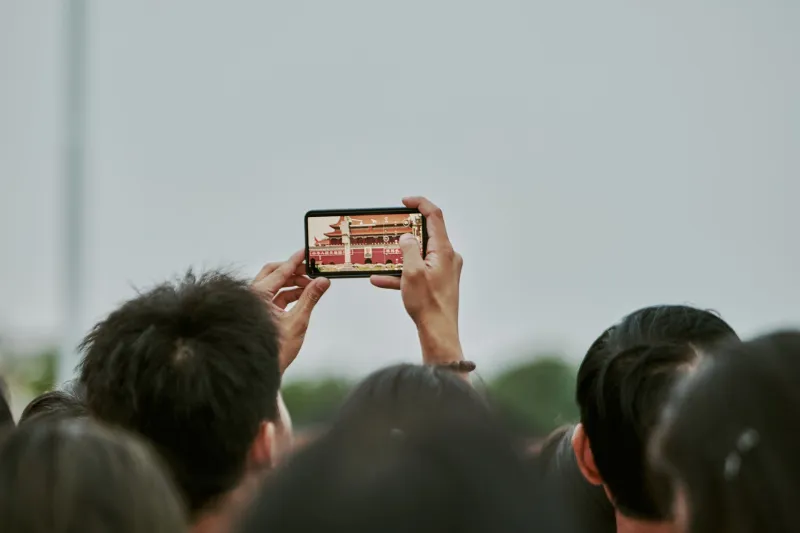
The contemporary traveler photographing a landmark from the outside is engaged in an activity structurally identical to the Grand Tourist commissioning a painting of the same landmark. Both are producing evidence. Both are converting the fact of presence into a portable object that can be displayed, shared, and used to establish the credential of having been there.
The photograph has one significant advantage over the painting: it is instantaneous. This means that the time previously required to produce evidence—the sitting, the commission, the wait for the artist to finish—can now be redirected toward producing more evidence at more locations. The logical endpoint of this efficiency is the traveler who visits twelve European cities in ten days, photographing the exterior of each country's most recognizable landmark and departing before the light changes.
This traveler is not confused about what travel is for. He is simply operating under a different set of priorities than the traveler who spends three days in a single museum. Neither priority is inherently superior. Both are responses to the same underlying question: what do I need to bring back from this place to justify having gone there?
The Pilgrimage Logic of Proximity
There is a second and quite different explanation for exterior-only visits, one that has nothing to do with evidence and everything to do with what historians of religion call the logic of pilgrimage. In pilgrimage traditions across every culture, proximity to the sacred object is itself the transformative act. You do not need to touch the relic, enter the shrine, or understand the theology. You need only to have been near it. The nearness is the point.
This logic transfers to secular travel with remarkable fidelity. The traveler who stands outside the house where Abraham Lincoln was born, photographs it, and returns to the parking lot has accomplished something that matters to her—something that standing in her living room looking at a photograph of the same house would not have accomplished. The physical presence in the vicinity of a significant place carries a weight that representation cannot replicate.
The ancient world understood this intuitively. Roman tourists traveled to Troy not to excavate it but to stand near it. Medieval pilgrims walked to Canterbury not to study the architecture of the cathedral but to be in the presence of Becket's tomb. The exterior of the significant place was sufficient for the transformative purpose because the transformation required only proximity, not comprehension.
American travel behavior has inherited this logic almost entirely intact, applied now to secular shrines: the birthplaces of presidents, the sites of famous battles, the facades of buildings that appear in beloved films. We stand outside them because standing outside them is the act. The interior, in this framework, is supplementary.
The Honest Account of What We Achieve
Travel writing has been reluctant to acknowledge this pattern because it complicates the genre's central claim—that travel produces genuine transformation through genuine engagement. If a traveler can achieve her actual purposes by standing outside a building for eight minutes, what becomes of the literature that insists on the importance of deep immersion?
The honest answer is that different travelers travel for different reasons, and the exterior visit satisfies certain reasons quite well. It produces the credential of presence. It fulfills the pilgrimage logic of proximity. It generates the evidence required for the social performance of having traveled. These are not trivial achievements. They are the achievements that the majority of travelers, across the majority of human history, have actually sought.
The traveler who enters the museum and spends four hours in front of a single painting is pursuing something rarer and more demanding: genuine encounter with the thing itself, on the thing's own terms, without the mediation of the photograph or the credential. This is admirable. It is also, statistically, the minority behavior.
Understanding this does not diminish travel. It clarifies it. The threshold we choose not to cross tells us as much about what we came for as the rooms we enter. Both are honest answers to the question that every journey, consciously or not, is trying to resolve: what do I actually need from this place, and what am I willing to surrender in order to get it?