Filtered Light: How Americans Learned to Photograph the Trip They Wished They Were Having
There is a photograph that does not exist in anyone's vacation album. It shows the parking lot. It shows the admission line. It shows the crying child, the overpriced sandwich consumed standing up, the monument partially obscured by scaffolding that the travel brochure neglected to mention. This photograph was available to every traveler who ever packed a camera. Almost none of them took it.
What they took instead—what Americans have been taking for a hundred and forty years—is something closer to an argument. An argument that the trip was worth it. That the money was well spent, the days of leave justified, the self that chose this destination a self of discernment and good fortune. The photograph is not a record. It is a verdict.
Understanding why requires looking not at the images themselves but at the humans who made them, and at the remarkably stable psychological machinery that has operated behind every shutter click from the 1880s to this morning.
The First Editors
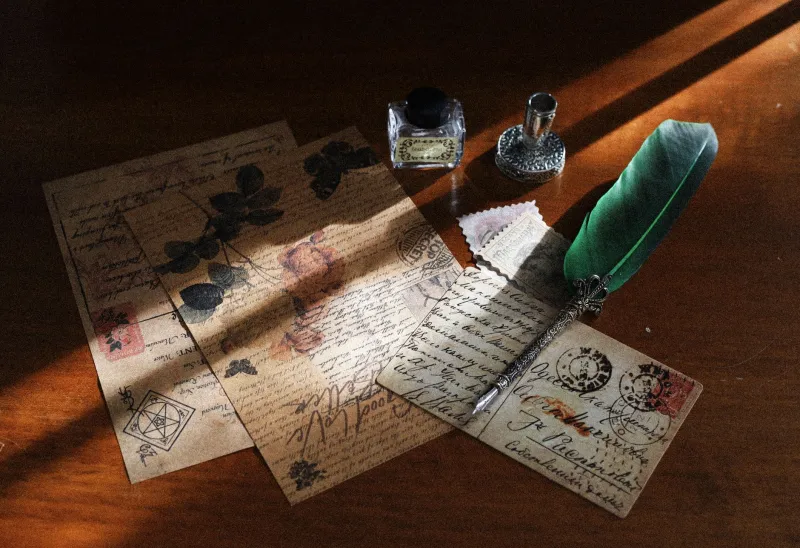
The picture postcard arrived in the United States in the 1870s, and by the first decade of the twentieth century it had become a minor national obsession. Between 1905 and 1915—a period collectors now call the Golden Age of postcards—Americans mailed approximately seven billion of them. Seven billion small rectangular arguments.
Those cards were not photographs in any documentary sense. They were hand-tinted, composited, and retouched by teams of craftsmen whose professional purpose was to make Niagara Falls bluer, the Grand Canyon more dramatic, and the resort hotel on the New Jersey shore look as though it occupied a coastline somewhere in the Mediterranean. The skies were always clear. The crowds were always absent. The light was always that particular golden hour that exists, in real geography, for approximately eleven minutes per day.
The people who sent these cards knew this. They had been there. They had stood in the actual rain, eaten the actual mediocre clam chowder, waited for the actual ferry. And then they selected the most impossible image available and wrote on the back: Having a wonderful time. Wish you were here.
Human psychology has not changed in five thousand years. What changed was only the technology available to execute the same impulse. The impulse itself—to transmit an edited version of experience rather than the experience itself—predates the postcard by the full length of recorded history. Roman tourists carved their names into Egyptian monuments and wrote home about the wonders they had witnessed. They did not write home about the dysentery.
The Camera as Social Instrument
When the Kodak Brownie democratized amateur photography in 1900, it did not democratize documentary instinct. It democratized aspiration. For the first time, ordinary Americans could produce their own evidence. They could construct, with their own hands, the visual record of the life they were living—or the life they preferred to appear to be living.
Social psychologists have a term for the behavior that follows: self-presentation. The theory, developed by Erving Goffman in the mid-twentieth century, holds that humans are perpetual performers, managing the impressions we create in others with the same strategic care an actor brings to a role. Travel photography is self-presentation with a shutter speed.
The Kodak advertisement campaigns of the early twentieth century understood this intuitively. They did not sell cameras as recording devices. They sold them as memory-makers—and the memories they depicted in their own advertising were invariably better than the ones their customers were actually having. The instruction was embedded in the marketing: here is what your photographs should look like. Here is the trip you should be documenting.
Americans received the instruction and followed it faithfully for a century.
What the Filter Actually Filters
The Instagram filter is, in this light, simply the latest iteration of the hand-tinting studio. The Valencia preset does what the postcard colorist did: it warms the light, saturates the color, and removes from the image anything that would complicate the emotional argument the photographer is trying to make.
But the contemporary version carries an additional weight that the postcard era did not. The 1910 postcard was sent to a specific person—a sister, a neighbor, a colleague—and its audience was knowable and finite. The Instagram post is broadcast to an indeterminate crowd, which means the anxiety behind the image is proportionally larger. You are no longer arguing that you had a good trip. You are arguing, to an audience of hundreds or thousands, that your life is the kind of life in which good trips happen.
This is a meaningfully different psychological transaction. And the evidence suggests that Americans understand, on some level, that it is happening. Survey after survey finds that travelers report feeling pressure to produce shareable content during their trips—that the act of documentation has begun to compete with, and in some cases displace, the act of experience. The photograph of the meal arrives on social media before the meal is eaten. The viewing platform at the canyon is studied through a four-inch screen rather than with the naked eye.
The traveler is no longer at the canyon. The traveler is at the production of a document about a person who was at the canyon.
The Anxiety the Image Conceals
What is the anxiety, exactly? It is worth naming directly, because it is older than photography and older than the postcard and older, probably, than any recording technology humans have ever invented.
It is the anxiety of wasted time. The fear that the experience did not justify the investment—of money, of days, of the particular self that was brought to the destination. Americans are, by cultural inheritance, a people who believe that time spent is time that must be accounted for. The Puritan ledger has never fully closed. Every vacation carries within it the implicit question: Was this worth it?
The photograph answers that question in the only language that cannot be easily disputed: visual evidence. Here is the sunset. Here is the cathedral. Here is my face in front of the thing that proves I was somewhere worth being. The image is not sent to inform. It is sent to settle the account.
This is not a pathology unique to Americans, but the American version has a particular intensity, shaped by a culture that has always been slightly suspicious of leisure and deeply invested in the idea that experience, like everything else, should yield a return.
The Long Memory of a Bad Photograph
There is a final irony worth noting. The photographs that survive in family archives—the ones that get passed down, framed, and genuinely treasured—are rarely the composed, filtered, argument-making images. They are the ones that escaped the editorial process. The one where someone's eyes are closed. The one where the rain is visible. The one where the clam chowder is on the table and everyone looks tired and faintly sunburned and completely, unmistakably, present.
The unedited image turns out to be the one with the longest memory. Which suggests that what the traveler was actually after—what the traveler has always been after, behind every tinted postcard and Valencia filter—was not the proof of a perfect experience. It was evidence of a real one.
The technology will keep improving. The filters will keep multiplying. The gap between the trip that happened and the trip that was photographed will remain exactly as wide as human anxiety requires it to be.