The Restless Gene: Why Americans Travel Like the Frontier Never Ended
The Operating System That Never Updated
Frederick Jackson Turner declared the frontier closed in 1893, but nobody told the American brain. More than 130 years later, we still pack our bags with the psychological expectation that something better, more authentic, and less discovered lies just beyond wherever we currently are. This isn't wanderlust—it's the inherited cognitive architecture of a people who spent 250 years believing that salvation always lay one ridge further west.
 Photo: Frederick Jackson Turner, via ecdn.teacherspayteachers.com
The numbers tell the story: Americans take shorter vacations than Europeans but change destinations more frequently. We book trips to "undiscovered" places that appear in major travel magazines. We use phrases like "off the beaten path" to describe destinations accessible by commercial airline. We've created an entire industry around the promise of finding what hasn't been found, even in a world where Google Earth has photographed every square inch of habitable land.
 Photo: Google Earth, via miro.medium.com
The Mythology of Movement
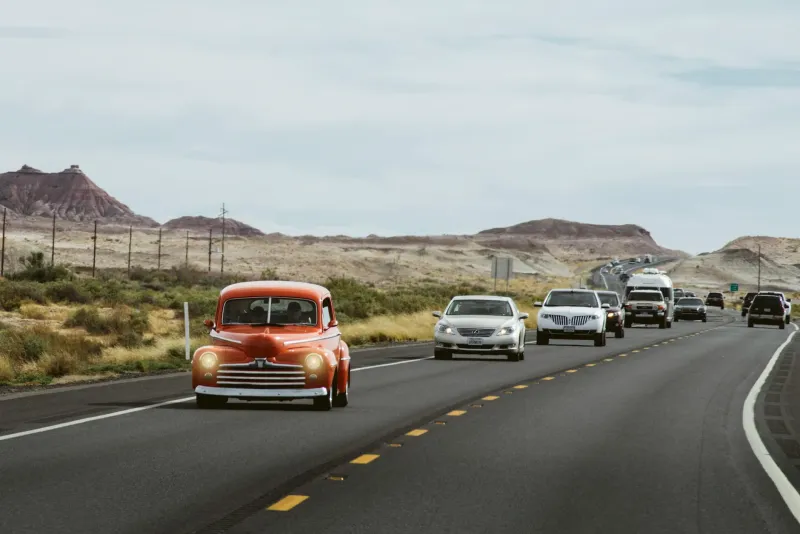
American travel culture inherited its core assumptions from the covered wagon experience: the belief that staying put equals stagnation, that comfort equals complacency, and that the act of moving itself has moral value independent of where you're going. This explains why we're the only culture that turned "road trip" into a spiritual concept.
Consider the language we use to describe travel decisions. Americans "escape" on vacation, as if our daily lives were prisons. We "get away" and "break free" and "hit the road," using the vocabulary of fugitives rather than tourists. Europeans "go on holiday" or "take a break"—temporary pauses in otherwise satisfactory lives. Americans "get out of town" as if staying were a form of moral failure.
The Paradox of Perpetual Discovery
The frontier psychology created a uniquely American paradox: we've become the world's most efficient producers of tourist infrastructure while maintaining the mythology that we're still explorers. We build interstate highways to pristine wilderness areas, then congratulate ourselves for "getting off the grid." We create national parks with visitor centers and gift shops, then feel authentic communing with nature in designated camping areas.
This isn't hypocrisy—it's the logical result of a culture that needs to believe in undiscovered territory while simultaneously needing to make that territory accessible to millions of people. The American solution is to manufacture the experience of discovery through careful staging and marketing.
Van Life and the Digital Frontier
Social media has given new expression to old frontier psychology. The van life movement isn't about living cheaply or simply—it's about maintaining the illusion of endless territory in a finished country. Instagram accounts document "nomadic" lifestyles that follow predictable circuits of photogenic locations, each presented as a personal discovery despite being visited by thousands of previous "nomads."
The van life aesthetic—pristine vehicles parked beside mountain lakes, carefully curated shots of minimal interiors, captions about "freedom" and "authenticity"—represents the frontier myth adapted for the smartphone era. The actual frontier required genuine hardship and uncertainty. The digital frontier requires only the appearance of both, plus reliable cell service for posting updates.
The Economics of Endless Elsewhere
American tourism economics reflect frontier psychology in ways that would puzzle travelers from more settled cultures. We'll pay premium prices for "authentic" experiences that simulate the hardships our ancestors endured by necessity. We book expensive "glamping" trips to experience camping without discomfort, wilderness lodges that provide frontier aesthetics with five-star amenities, and "adventure travel" that offers carefully managed risk.
This isn't masochism—it's the market responding to a psychological need to feel like pioneers while maintaining the safety and convenience of modern civilization. We've created an industry that sells frontier experiences to post-frontier people.
The Constant Search for Elsewhere
The frontier never actually offered what Americans thought it offered. The historical record shows that most westward migrants were seeking economic opportunity, not spiritual transformation. They wanted farmland, not enlightenment. But the mythology that developed around westward expansion promised that geographic change could produce personal change—that moving your body could move your soul.
This belief explains why American travel culture emphasizes transformation over relaxation. We don't just go places; we expect places to change us. We return from trips talking about how the experience "opened our eyes" or "put things in perspective" or "reminded us what matters." The destination becomes a catalyst for internal change rather than simply a different location.
The Inheritance of Impermanence
Frontier psychology taught Americans that attachment to place was a luxury we couldn't afford. The next drought, the next economic downturn, the next opportunity might require pulling up stakes and starting over. This created a culture uniquely comfortable with impermanence—and uniquely addicted to the possibility of escape.
Modern American travel reflects this inherited comfort with impermanence. We're more likely than other nationalities to book one-way tickets, to extend trips indefinitely, to quit jobs for travel, to sell belongings for experiences. We've turned mobility itself into a virtue, even when we're not moving toward anything specific.
The Map That Ate the Territory
The ultimate expression of frontier psychology in the age of GPS is our relationship with travel planning. We research destinations exhaustively before visiting them, read reviews, study maps, plan itineraries—then feel disappointed when the actual place matches our expectations too closely. We want to be surprised by places we've already thoroughly investigated.
This contradiction reveals the deeper truth about American travel psychology: we're not really looking for new places. We're looking for the feeling of discovery that new places once provided. We want to experience what our frontier ancestors experienced—the excitement of not knowing what lies beyond the next hill—but we want to experience it safely, comfortably, and on schedule.
The frontier closed more than a century ago, but the psychological operating system it installed continues to run in the background of American consciousness, generating a restlessness that no amount of actual travel can fully satisfy. We keep moving because movement itself has become our definition of progress, even when we're traveling in circles.