Democracy at the Lunch Counter: How America's Roadside Diners Measured Our Capacity for Equality
The Colonial Ordinary: Democracy by Dinner Bell
In 1750, if you wanted to eat while traveling through colonial America, you had exactly one option: the ordinary table. Every tavern served the same meal, at the same time, for the same price, to every customer who walked through the door. The wealthy merchant sat next to the itinerant preacher, who sat next to the traveling craftsman, who sat next to the runaway apprentice. Social hierarchy didn't disappear at the ordinary table—it was temporarily suspended by the simple reality that everyone needed to eat.
This wasn't hospitality; it was practical economics. Colonial tavern keepers couldn't afford to maintain separate dining rooms for different classes of customers, and the limited transportation infrastructure meant that travelers arrived when they arrived, not when it was convenient for elaborate social choreography. The ordinary table represented accidental equality—democracy born from logistical necessity rather than political ideology.
But the psychological impact was profound. For many Americans, the tavern table was their first experience of eating with strangers from different social classes, different regions, different backgrounds. The shared meal created a temporary social contract: for the duration of dinner, everyone was simply a hungry traveler deserving of the same food and the same basic courtesy. This experience of enforced equality would echo through three centuries of American dining culture.
The Counter Revolution: Industrializing Intimacy
The lunch counter, introduced in the 1880s, represented both an evolution and a revolution in American democratic dining. By arranging customers in a line facing the kitchen, the counter eliminated the need for table conversation while maintaining physical proximity. You could eat next to a stranger without having to acknowledge their existence—a perfect solution for an increasingly urban and anonymous society.
The counter also solved a practical problem that had plagued American restaurants since the colonial era: how to serve customers quickly during the limited time windows when working people could afford to eat out. The lunch counter turned eating into an efficient, almost industrial process. Customers sat down, ordered from a limited menu, ate quickly, and left. The social experiment of the ordinary table was replaced by the social efficiency of the assembly line.
But efficiency came with unexpected social consequences. The lunch counter created a new form of enforced intimacy—strangers sitting elbow to elbow, sharing counter space, overhearing each other's conversations with the waitress. The physical arrangement made traditional social boundaries harder to maintain. A factory worker and a bank clerk might never speak to each other, but they shared the same counter, ate the same food, and participated in the same brief social ritual of ordering, eating, and paying.
The Diner as Social Laboratory
By the 1920s, the American diner had evolved into the nation's most democratic institution—more egalitarian than churches, which segregated by denomination; more inclusive than schools, which segregated by neighborhood; more accessible than hotels, which segregated by price. The diner counter didn't eliminate social differences, but it created a space where those differences were temporarily irrelevant.
This democratic function wasn't accidental. Diner owners discovered that their most profitable customers were the ones who felt comfortable eating next to anyone—travelers, shift workers, and other people whose schedules or circumstances placed them outside normal social hierarchies. The diner succeeded commercially by serving people who couldn't afford to be socially selective about their dining companions.
The result was a unique American institution: a space where democracy was practiced rather than preached. The diner counter forced customers to negotiate the basic challenges of democratic society in miniature—sharing space with strangers, tolerating different behaviors and opinions, and finding common ground through the universal experience of hunger. Every successful diner was proof that Americans could get along with each other when the alternative was going hungry.
The Architecture of Egalitarian Eating
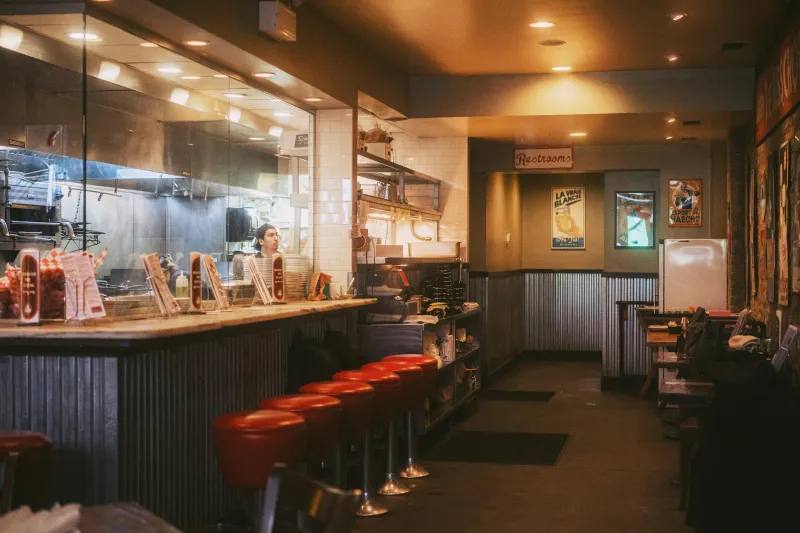
The physical design of the classic American diner reveals sophisticated thinking about how to create democratic space. The counter arrangement ensured that every seat was equally close to the action—no VIP tables, no corners where important people could eat undisturbed. The open kitchen made food preparation visible to all customers, eliminating suspicions about whether different customers were receiving different quality meals.
The uniform stools, identical place settings, and standardized menu pricing sent clear signals about social expectations: this was a place where everyone was treated the same way. Even the famous diner coffee cup—thick, white, and unbreakable—was designed to be democratic. Unlike the delicate china that signaled refinement in upscale restaurants, the diner mug was built for utility and equality.
The waitress uniform served a similar function. By dressing service staff in identical outfits, diners eliminated visual cues about individual servers' social backgrounds or personal preferences. The uniform transformed individual women into representatives of institutional hospitality—democracy through standardization.
The Civil Rights Counter Test
The lunch counter sit-ins of the 1960s weren't accidental choices of venue. Civil rights activists understood that the diner counter represented America's most visible commitment to democratic equality. By demanding service at lunch counters that excluded Black customers, the protesters were exposing the contradiction between America's democratic dining ideals and its segregated reality.
The choice of lunch counters as protest sites was strategically brilliant because it forced white America to confront the gap between democratic theory and democratic practice in the most mundane possible setting. The ordinary table had promised equality for all hungry travelers; the lunch counter had delivered on that promise for white customers only. The sit-ins demanded that America live up to its own dining room democracy.
The violent resistance to lunch counter integration revealed how much social anxiety the democratic diner had been managing through exclusion. White customers who had been comfortable eating next to working-class strangers, foreign immigrants, and social outcasts drew the line at eating next to Black Americans. The lunch counter became a precise instrument for measuring exactly how much equality white America could actually tolerate.
 Photo: Black Americans, via wallpaperaccess.com
The Suburban Retreat from Democratic Dining
The decline of the traditional diner counter began in the 1970s, not because the format stopped working, but because Americans stopped wanting it to work. The suburban restaurant boom offered new dining options that promised to eliminate the social unpredictability that had defined diner culture. Chain restaurants, family dining rooms, and booth seating allowed customers to control their social environment more precisely.
The shift from counter to booth seating wasn't just about comfort—it was about social control. Booths allowed customers to create temporary private dining rooms, eliminating unwanted interactions with strangers. The democratic experiment of the diner counter was replaced by the social selectivity of chosen dining companions.
This transformation reflected broader changes in American social trust. The generation that had grown up eating at lunch counters alongside strangers was replaced by generations that preferred the predictability of chain restaurants and the social isolation of drive-through windows. The decline of the diner counter mapped perfectly onto the decline of other forms of democratic social mixing—neighborhood schools, public transportation, civic organizations.
Reading the Counter Culture Tea Leaves
The few surviving traditional diners function as social time machines, preserving a form of democratic interaction that has largely vanished from American life. Visiting a classic lunch counter today provides a direct experience of what American social trust used to look like—and a stark contrast to what it has become.
Modern restaurant design reveals our contemporary comfort level with democratic dining. The proliferation of private dining rooms, VIP sections, and socially segregated seating arrangements shows how far we've retreated from the egalitarian ideals of the ordinary table. Even casual dining chains now offer "premium" seating options that allow customers to pay for social distance from other diners.
The Future of Democratic Dining
The disappearance of the traditional diner counter predicts broader changes in American social cohesion. A society that can't tolerate eating next to strangers is unlikely to tolerate the other forms of proximity that democracy requires—shared public transportation, integrated neighborhoods, common civic spaces.
But the psychology that made the diner counter work hasn't disappeared—it's been redirected into new venues. Food trucks, farmers markets, and communal dining experiences at craft breweries represent attempts to recreate the democratic mixing that traditional diners once provided. These new formats suggest that Americans still crave the social connection that comes from sharing food with strangers; we've just become more selective about the terms under which we're willing to do it.
The next time you sit at a lunch counter—if you can find one—you're participating in one of America's oldest experiments in practical democracy. The questions the counter forces you to navigate—how to share space with strangers, how to tolerate different behaviors, how to find common ground through common needs—are the same questions that democratic society must answer to survive. The way we handle lunch counter democracy predicts how we'll handle every other kind.