The Trophy Instinct: How Conquerors and Vacationers Shop the Same Way
Roman legionnaires stripped Greek temples. Napoleonic officers catalogued Egyptian monuments before shipping them west. American GIs packed German sidearms into their duffel bags. The pattern is so consistent across millennia that it demands a more serious explanation than simple greed — and that explanation turns out to illuminate something uncomfortable about the most ordinary vacation shopping trip.
The conquest souvenir is a distinct psychological category, and understanding it requires separating it from the ordinary keepsake. Both involve bringing something physical home from a journey. But the ordinary keepsake commemorates an experience. The conquest souvenir does something more specific: it commemorates an encounter with power — and the traveler's position, however briefly, on the winning side of it.
What the Legionnaire Needed
When Roman soldiers returned from the Greek campaigns of the second century BCE, they did not merely bring home loot in the conventional military sense. They brought home the physical evidence of a civilization they had been taught to revere and had now, astonishingly, defeated. The statues, the bronzes, the painted panels — these were not simply valuable objects. They were proof of a transaction that the soldier's own memory could not adequately record.
Memory, as cognitive science has repeatedly confirmed, is unreliable under conditions of intense experience. The more overwhelming an event, the less accurately it tends to be preserved in pure recollection. This is not a modern discovery. Every culture in the historical record has understood, at some practical level, that the mind requires external anchors to hold extraordinary experiences in place. The object does what memory cannot: it does not fade, does not revise itself, does not become uncertain under questioning.
For the legionnaire carrying a Greek bronze back to his apartment on the Aventine Hill, the object served a precise function. It answered, permanently and tangibly, the question that every returning traveler faces: Was it real? Did it actually happen? Did I actually stand in the place where those things occurred?
 Photo: Aventine Hill, via italyxp.com
The trophy said yes. Unambiguously, physically, every morning when he walked past it.
The Napoleon Problem
The Napoleonic Egyptian campaign of 1798 produced one of history's most consequential acts of organized souvenir collection. The army that accompanied Napoleon to the Nile included not only soldiers but a corps of scholars, artists, and scientists whose explicit mission was to document, measure, and where possible remove the physical remnants of ancient Egyptian civilization.
The resulting Description de l'Égypte — a monumental multi-volume catalogue of Egyptian antiquities — was simultaneously a work of genuine scholarship and an act of imperial possession. France did not merely observe Egypt. It consumed it intellectually and physically, carrying the Rosetta Stone and hundreds of other artifacts back to Paris as evidence of an encounter that had occurred at the intersection of military force and civilizational curiosity.
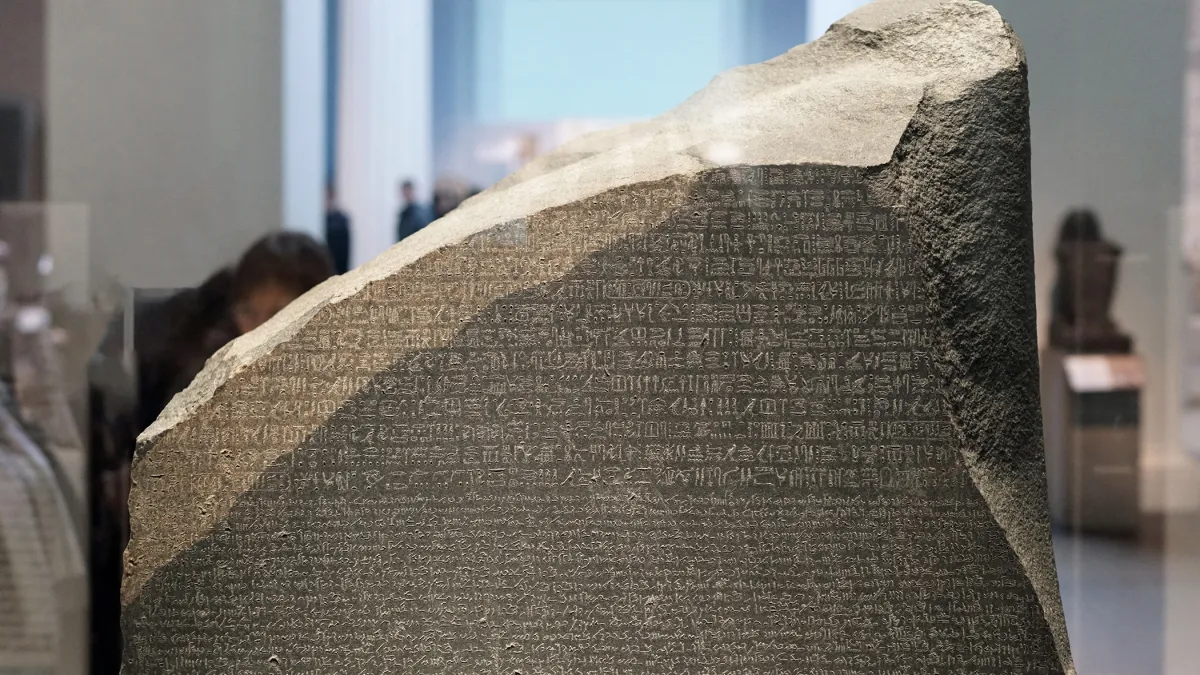 Photo: Rosetta Stone, via smarthistory.org
What is instructive here is not the scale of the appropriation but its motivation. The French officers who supervised the collection of Egyptian artifacts were not, for the most part, crude opportunists. Many were genuinely educated men with authentic intellectual interests. They wanted these objects because proximity to conquered greatness felt like a form of inheritance — as though the act of taking possession transferred some quality of the original civilization to its new owners.
This is the conquest souvenir's deepest psychological logic: not merely to remember the encounter, but to absorb something from it. To carry home not just proof that you were there, but evidence that the place changed you — that you took something real away from the exchange.
The GI's Luger
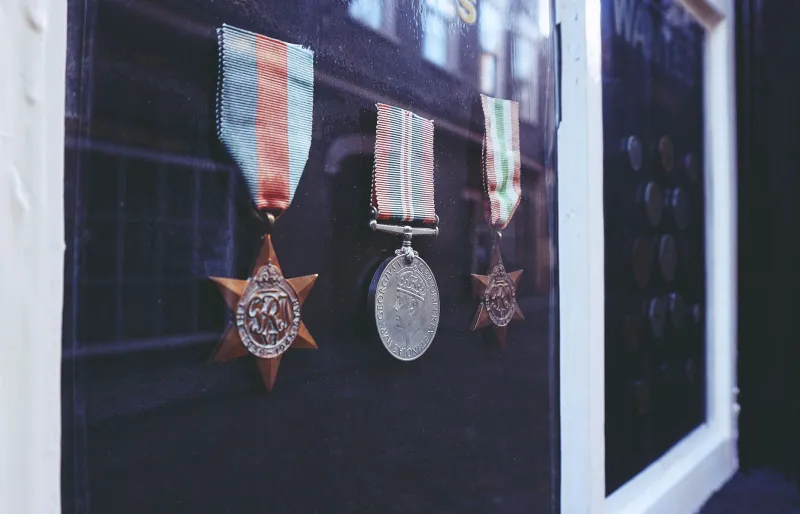
The American souvenir tradition emerging from the Second World War is better documented than most, partly because the objects themselves are still circulating through estate sales and gun shows across the country. The German Luger pistol, the Japanese officer's sword, the Nazi insignia carefully removed from a uniform — these were the conquest souvenirs of the mid-twentieth century's most decisive military encounter, and they were collected in enormous quantities.
Veterans who brought these items home rarely described themselves as trophy hunters. The language they used was almost always more modest: a memento, a reminder, something to show the grandchildren. But the objects they selected were, with striking consistency, objects that had belonged to the enemy specifically — not the landscape, not the architecture, not the local food. The enemy's weapon. The enemy's rank insignia. The physical tokens of opposing power, now in the possession of the man who had, in some meaningful sense, overcome it.
The psychological function is identical to the legionnaire's Greek bronze, separated by two thousand years and an ocean. The object answers the same question and performs the same service. It makes the encounter permanent and legible in a way that memory alone cannot sustain.
The Vacation Aisle
None of this would require examination if it stayed in the domain of military history. The uncomfortable observation — the one that gives this pattern genuine relevance for the traveler — is that the same psychological architecture appears in contexts with no military dimension whatsoever.
Consider what the average American tourist selects in a gift shop. Generic items — the refrigerator magnet, the novelty mug — are purchased for others, as social tokens. But the items people buy for themselves tend to cluster around a different principle. They reach for things that feel specifically of the place: the locally made object, the artisan product, the item that could not plausibly have come from anywhere else. The more exotic or remote the destination, the more intensely this preference operates.
What they are doing, without using the language, is the same thing the legionnaire did. They are acquiring physical evidence of an encounter with something larger than their ordinary life — a place with its own history, its own power, its own claim on the world's attention. The souvenir says: I was there. I engaged with that. I brought something real back from the exchange.
The conquest framing is absent, obviously. No one is defeated. But the underlying need — to possess a fragment of the overwhelming, to anchor an extraordinary experience in something that will not revise itself — is operating on precisely the same psychological mechanism.
Traveling with This Knowledge
Recognizing the trophy instinct does not require abandoning it. It requires understanding what it is actually doing.
The traveler who knows why they reach for a particular object in a particular shop is in a better position to reach for the right one. The question worth asking, before the purchase, is not merely Do I like this? but What encounter am I trying to preserve, and does this object actually hold it?
History's most discerning collectors — and the legionnaire who chose a specific bronze over a pile of silver coin was, in his way, making an aesthetic and psychological judgment — selected objects that bore a genuine relationship to the encounter they were trying to anchor. The worst souvenir purchases, in every era, have been the ones made in haste, driven by the anxiety of leaving without proof rather than by any real connection to the object itself.
The trophy instinct is not going away. It is too old and too deeply embedded in how human memory works. The traveler's task is simply to shop like someone who understands what they are actually buying.