Proof of Presence: The Postcard You Bought and Never Addressed
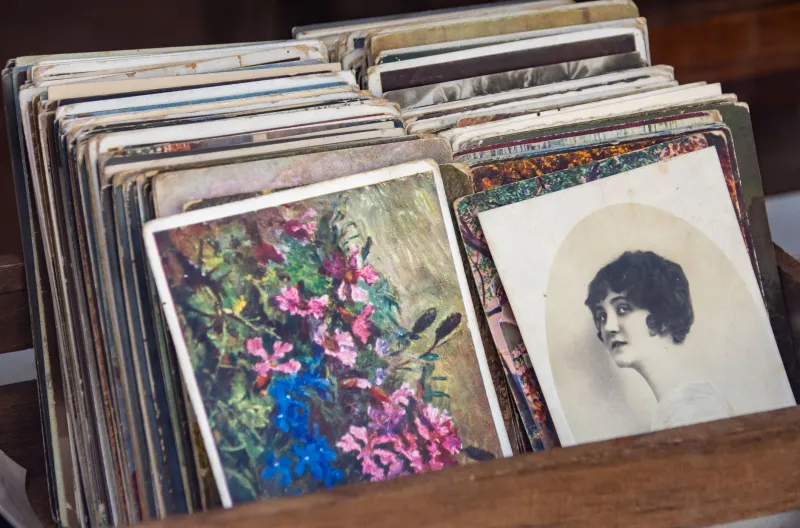
Somewhere in a drawer—perhaps in a childhood home, perhaps in a box that has survived three moves without being opened—there is a postcard. The image on its face is vivid: a turquoise bay, a red-rock formation, a city skyline rendered in the saturated colors of a decade you can almost name. The reverse is blank. It was blank when you bought it. It has remained blank ever since. You kept it anyway.
This is not a confession of negligence. It is a record of something far more interesting.
The Golden Age of the Undelivered Message
The postcard arrived in American popular culture in the 1890s and achieved something close to mania by the early 1900s. The years between roughly 1905 and 1915 are known among collectors as the Golden Age of postcards, a period during which Americans mailed more than 900 million cards annually. The infrastructure was extraordinary: multiple mail deliveries per day in major cities meant a card posted in the morning could be read by afternoon. The postcard was, for a brief moment, the text message of its era.
But even then, at the height of the form's communicative function, something else was happening alongside the correspondence. People were collecting. Albums designed specifically to hold postcard collections sold in enormous quantities. Americans were acquiring cards they had no intention of sending—purchasing them at resort towns, train depots, and exposition halls and filing them alongside cards received from others, building visual libraries of places they had been, or wished they had been, or simply found beautiful.
The collecting impulse and the communicative impulse operated simultaneously and, frequently, in competition. Many cards were bought in sets, their backs never touched by pen or stamp.
What the Image Was Actually Doing
To understand why, it helps to consider what a postcard image accomplishes that a written description cannot. A card bearing a photograph of Niagara Falls, purchased at the falls themselves, does something specific: it confirms that the falls exist, that they are as dramatic as reported, and that the buyer was there to confirm it. The image is a receipt. The fact that no one else receives it does not diminish its function—because the primary audience was never the addressee. It was the traveler.
Human psychology has not changed materially in five thousand years. The need to document experience, to create tangible evidence that a significant event occurred, predates writing itself. Cave paintings are, among other things, records of presence. Egyptian travelers scratched their names into monuments they visited—a practice that persisted through the Roman period, the medieval era, and into modernity. The postcard is merely the industrialized version of this impulse: a professionally produced confirmation that a place exists and that you stood before it.
The blank reverse is not a failure to communicate. It is evidence that communication was never the primary purpose.
The Album as Private Archive
By the mid-twentieth century, the postcard album had become a fixture of American domestic life. These collections were rarely displayed. They were consulted privately, pulled from shelves on winter evenings or during moments of retrospective mood. They functioned less like scrapbooks—which are often made for an audience—and more like journals: ordered accumulations of personal experience that derived their meaning from the collector's private relationship with the images.
The distinction matters. A scrapbook invites a viewer. A postcard album, in most cases, does not. The cards were arranged by the traveler for the traveler, a sequence of visual memories organized according to logic that only the collector fully understood. The Grand Canyon card placed beside the Hoover Dam card beside the card from a motel in Flagstaff told a story—but it was a story with an audience of one.
This is not solipsism. It is memory management. The brain's capacity for episodic memory is imperfect, and external objects have always served as anchors for experience that would otherwise drift. Anthropologists studying material culture have documented this function across every human society examined: objects are used to store meaning that the mind alone cannot reliably hold. The postcard was an exceptionally efficient tool for this purpose, combining visual specificity with physical portability at a price nearly anyone could afford.
The Aspirational Card
There is a second category of unaddressed postcard that complicates the picture further: the card purchased not to commemorate a place visited, but to represent a place desired. Collectors of early twentieth-century postcards regularly encounter cards from destinations that the original owner almost certainly never visited—exotic ports, European capitals, Western landscapes that were, for most Americans of that era, genuinely inaccessible.
These aspirational cards were sold in department stores, at expositions, and through mail-order catalogs. They were purchased and filed alongside cards from places actually visited, creating collections that blended memory and longing without distinction. The album did not differentiate between what had happened and what was wished for. This, too, is a recognizable human behavior. The ancient Romans kept paintings of landscapes they had never seen. Medieval pilgrims collected badges from shrines they had not visited, either as proxies for journeys they could not make or as expressions of devotion that did not require physical presence.
The American postcard collector was working within a tradition far older than the postcard itself.
What the Drawer Holds Now
The postcard as a medium of correspondence is effectively finished. The infrastructure that made it practical—the multiple daily deliveries, the penny stamp, the corner drugstore rack—has largely dissolved. But the collecting impulse has not. It has migrated. The phone camera roll is, in many respects, the contemporary postcard album: thousands of images, almost none of them shared, organized in a sequence that only the photographer fully understands, consulted privately and rarely shown in full to anyone.
The image of the canyon rim. The hotel lobby at golden hour. The meal that seemed worth documenting before it was eaten. These photographs are not taken for an audience. They are taken for the same reason Americans spent a century buying postcards they never addressed: because the experience demands a record, and the record's primary value is the proof it offers to the person who was there.
The drawer has simply gone digital. The impulse it holds is ancient.