Three A.M. in the Corridor: What the Sleepless Traveler Has Always Been Looking For
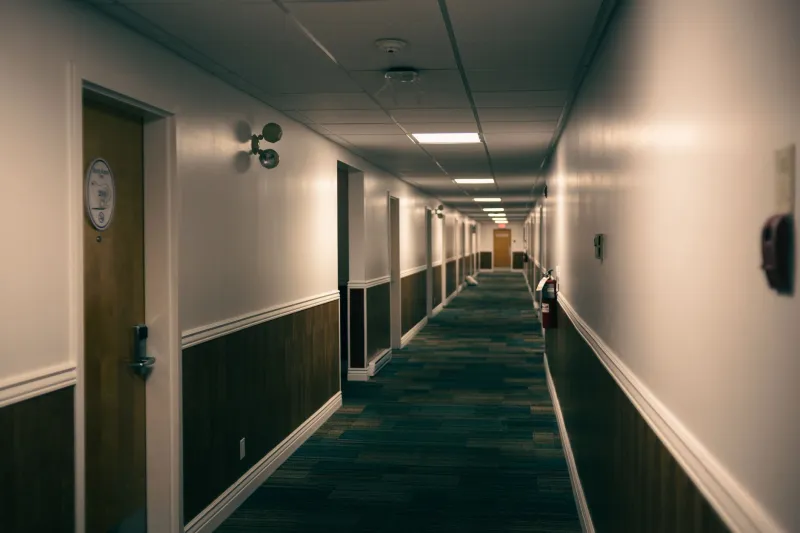
The elevator hums at three in the morning. A door opens somewhere down the hall. Footsteps move without apparent destination — past the ice machine, past the vending alcove with its institutional glow, around the corner toward the emergency exit that no one intends to use. Then back. Then, eventually, to bed.
This is not insomnia in any clinical sense. It is something older than that word, and more specific to the condition of being away from home.
Travelers have always done this. The form changes with the architecture of each era — the Roman traveler pacing the courtyard of a mansio, the 18th-century coach passenger standing in the innyard listening to horses shift in their stalls, the 20th-century motorist stepping onto the exterior walkway of a highway motel to look at the parking lot for no reason he could name. The behavior is consistent enough across centuries to suggest it is not a malfunction. It is a mechanism.
The Body Keeps Its Own Ledger
Human sleep has never been fully portable. That is not a modern complaint. The Roman writer Pliny the Younger noted the difficulty of sleeping in unfamiliar houses. Medieval pilgrims traveling to Canterbury or Santiago de Compostela described the particular restlessness of dormitory sleep in a hostel full of strangers. The body, it seems, maintains an internal record of what constitutes a safe place to lose consciousness, and a hotel room — regardless of its thread count — does not automatically qualify.
Neuroscientists have recently given this phenomenon a name: the "first-night effect," in which one hemisphere of the brain remains in a lighter state of vigilance when sleeping in an unfamiliar environment. The brain, in other words, assigns a sentinel to stand watch. But this discovery only confirms what five thousand years of travel literature already implied: the traveler's body does not trust the room.
What the research cannot fully explain is what happens next. Because the sleepless traveler does not merely lie awake. He gets up. He goes out. And there is something purposeful about the way he moves through the dark corridor, even when — especially when — he has nowhere particular to go.
The Inspection as Ancient Ritual
Consider what the midnight wanderer actually does. He examines the floor plan posted behind the door. He notes the distance to the stairwell. He finds the ice machine and observes it without using it. He may ride the elevator to a random floor and return. He reads the exit signs with a thoroughness he would never apply during daylight hours.
This is reconnaissance. And it is not irrational.
Before fixed settlements became the dominant human arrangement — before the inn, the hotel, the Airbnb — sleeping in an unknown place required exactly this kind of prior survey. Where are the exits? What sounds belong to this environment and which do not? Who else is here, and where are they? The traveler who went to sleep without answering these questions was the traveler who did not always wake up.
The behavior encoded itself deeply enough to survive ten thousand years of architectural progress. The hotel corridor has replaced the forest clearing, but the impulse to walk the perimeter before surrendering to sleep has not been engineered away. It has merely been redirected toward ice machines and illuminated exit signs.
Control in a Temporary Space
There is a second layer to the midnight walk that has less to do with survival and more to do with sovereignty.
A hotel room is, by definition, a space that belongs to someone else. The traveler occupies it under temporary license. He did not choose its colors, its furniture arrangement, its smell, or the particular quality of its silence. He arrived to find it fully formed, indifferent to his preferences, and scheduled to be returned to its original condition the moment he departs.
This is an unusual psychological situation, and the human response to it is consistent across cultures and centuries: we assert small dominions. We rearrange the pillows. We move the desk chair. We unpack more than necessary. We establish, through minor territorial gestures, that the space has acknowledged our presence.
The three a.m. walk is an extension of this same impulse. By moving through the corridor — by learning the layout, by establishing that he can navigate this foreign geography without assistance — the traveler converts the anonymous building into something he partially knows. He is not wandering. He is mapping. And the map, once made, is enough to allow sleep.
What the Ancients Would Have Recognized
The 19th-century traveler Bayard Taylor, who crossed three continents and wrote exhaustively about the experience, described the specific unease of waking in an unfamiliar room and not knowing, for several seconds, which country he was in. He called it "the geography of waking" — the brief, disorienting period before memory supplies location. His solution was to rise and walk, to gather sensory evidence until the room declared itself.
This is precisely what the modern traveler does at three in the morning, though he would not describe it in those terms. He is gathering evidence. He is resolving the geography of waking.
The caravanserais of the ancient Silk Road were designed, among other purposes, to give travelers a defensible perimeter — a walled enclosure where the exits were known and the population was visible. The Roman road system's overnight stations were built to a standardized plan, in part so that the frequent traveler would find each one legible upon arrival. Familiarity, even artificial familiarity, reduces the cost of sleeping in a strange place.
The modern hotel chain understood this intuitively long before it understood it consciously. Standardized room layouts. Identical furniture arrangements. The same branded coffee maker on the same side of the same desk. These are not merely cost efficiencies. They are an attempt to pre-answer the questions the traveler's body will ask at three in the morning.
They do not always work. And so the traveler rises.
What the Hallway Confesses
The midnight corridor is one of the few places where the traveler appears without performance. No one he knows will see him there. He has not dressed for an audience. He carries nothing that signals his purpose or identity. He is simply a person moving through a lit hallway in the middle of the night, trying to make a temporary place legible enough to sleep in.
This is the traveler at his most honest. Not the version who photographs the lobby or reviews the breakfast, but the version who cannot quite surrender to unconsciousness in a room that has not yet earned his trust.
Five thousand years of human movement suggest that this is not a weakness. It is, rather, one of the more durable pieces of evidence that the traveler's body is paying attention — that it has not forgotten, beneath all the accumulated comfort of modern lodging, what it once cost to sleep somewhere unfamiliar.
The ice machine hums. The exit sign burns its steady red. The traveler returns to his room and, having walked the perimeter, finally sleeps.