Chosen by Bureaucrats: How Federal Mail Contracts Drew the Map of American Prosperity
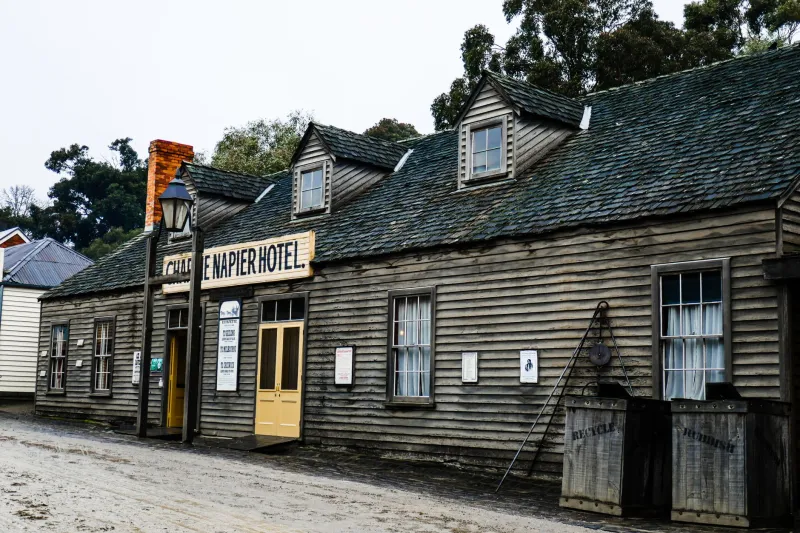
There is a particular kind of American town that feels as though it has always been there — the kind with a wide main street, a courthouse set back from a square, and a hotel whose bones date to the early nineteenth century. Travelers pass through and sense, without being able to articulate why, that this place was meant to be here. The feeling is not wrong, exactly. It is simply misattributed. The town was not chosen by geography. It was chosen by a contract.
Long before the railroad surveyor or the highway engineer arrived with their instruments, the United States Post Office Department was quietly performing an act of nation-building so consequential that its effects are still legible in the landscape. Between roughly 1790 and 1860, federal mail contracts — awarded to private stagecoach operators along congressionally approved routes — functioned as the original infrastructure of American commerce, settlement, and, eventually, leisure travel. To be on the mail route was to exist in the economic imagination of the young republic. To be bypassed was to begin a slow disappearance that no amount of local ambition could fully reverse.
The Invisible Hand of the Postmaster General
The mechanics of the system were straightforward, and their consequences were enormous. Congress appropriated funds; the Post Office Department awarded contracts to operators willing to carry mail along specified corridors on specified schedules. The contractors, in turn, needed horses, drivers, way stations, and overnight inns. Every twenty miles or so, an inn had to exist — to change teams, to feed passengers, to provide a bed when darkness or weather made further progress impossible.
The proprietors of these inns did not build them speculatively. They built them because the route came to them, or they lobbied their congressman until it did. The distinction matters. Human psychology has always operated this way: people do not simply respond to opportunity; they maneuver to be placed in its path. The postmasters general of the early republic understood this, which is why the awarding of mail contracts was, from the very beginning, a deeply political act dressed in the language of public service.
Routes followed not the most efficient topography but the most useful political geography. A congressman from western Virginia needed a mail road through his district. A senator from Georgia had constituents in a river valley that the logical route would have bypassed. The horse-trading that produced the national mail network was not so different from the horse-trading that produces a modern highway appropriations bill. The technology changes. The psychology does not.
The Inn That Became an Institution
For the traveler of the early nineteenth century, the mail-route inn was something close to sacred infrastructure. It was the only place in a day's journey where food was reliably available, where a horse could be exchanged for a fresh one, and where news — carried in the mail pouches — arrived before it reached anyone else. The inn at a mail-route junction was, in miniature, what a major airport hub is today: a point of convergence that accrued value simply by being the place where things connected.
Some of these establishments grew into genuine institutions. The taverns along the Boston Post Road, which carried mail between New York and Boston from the colonial period onward, evolved over generations into the kind of landmark that travelers mentioned in letters home. Their names entered the vernacular. Their proprietors became minor celebrities. The road itself became, in the American imagination, a scenic corridor — not because its landscape was especially distinguished, but because the density of human activity along it had trained generations of travelers to look at it with expectation.
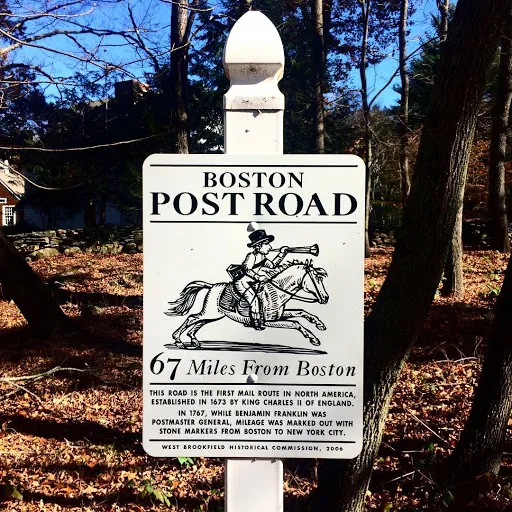 Photo: Boston Post Road, via lh3.googleusercontent.com
This is the mechanism worth understanding. Scenery, as Americans experience it, is rarely a pure response to geography. It is a response to the accumulated attention that a place has received. The mail route created the attention. The attention created the scenery. The scenery eventually created the tourism industry.
What the Bypassed Towns Teach Us
The darker side of this history is visible in the towns that the mail routes did not choose. Across the eastern United States, there are communities that show every sign of having once expected a different future — wide streets platted for a commerce that never fully arrived, courthouses slightly too grand for the populations that now use them, hotel facades from the 1830s that have been everything from a hardware store to a thrift shop in the intervening two centuries.
These places were not failures of local ambition. They were, in many cases, victims of a contract that went to a rival county, a route adjustment made in Washington by men who had never seen the terrain in question. The psychological residue of being bypassed is something that historians of American small towns have documented repeatedly: a persistent sense of grievance, a conviction that the community was cheated of its rightful place in the national story. That conviction is not delusional. It is, in most cases, historically accurate.
For the modern traveler, these bypassed towns offer something that the well-traveled corridor cannot: the strange melancholy of a place that was almost something else. They are, in their own way, as instructive as the prosperous mail-route towns, because they make visible the contingency that the prosperous towns have learned to disguise as inevitability.
Reading the Road You're Already On
The practical implication for anyone planning travel in the United States is this: the roads that feel natural — the ones that pass through a logical succession of towns with good restaurants and comfortable inns — are natural only in the sense that they have been used long enough to seem inevitable. Their logic is political and historical, not geographical.
If you drive the old Boston Post Road through Connecticut, or follow the National Road across Maryland and Pennsylvania, or take the old Natchez Trace through Tennessee and Mississippi, you are traveling a path that was chosen for you by men who died two hundred years ago, men who were balancing constituent demands and contractor relationships and the perpetual American argument over which direction the country was supposed to grow.
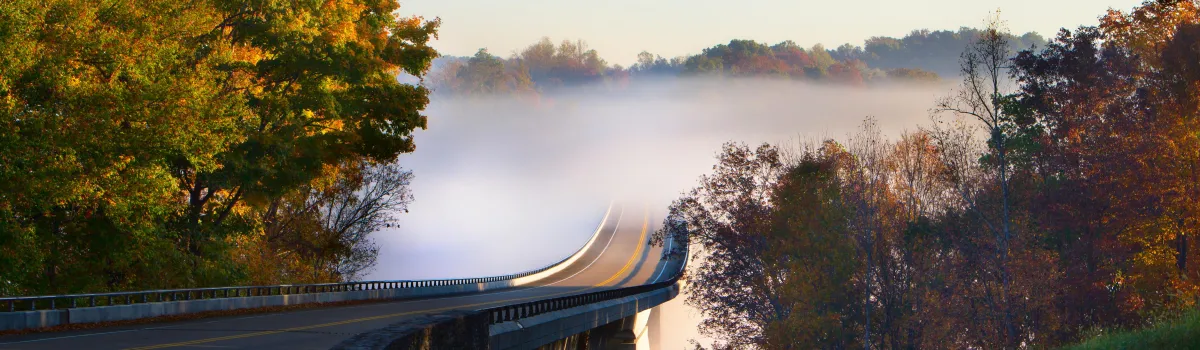 Photo: Natchez Trace, via www.nps.gov
Knowing this does not diminish the journey. It deepens it. Every prosperous town you pass through is a monument to a contract that was awarded. Every struggling one is a monument to a contract that was not. The landscape is not neutral. It is, and has always been, a record of decisions made by people with interests — and the traveler who reads it as such sees considerably more than the one who takes the road for granted.
The postmaster general's secret was never really a secret. It was simply a truth that prosperity has always preferred to forget.