What They Left Behind the Door: The Enduring Human Need to Speak to the Stranger Not Yet Arrived

There is a drawer in nearly every American hotel room that contains a Bible. It has been there, in one form or another, since the Gideons International began their distribution campaign in 1908. Most guests never open it. A significant number don't notice it exists. And yet it persists — restocked, repositioned, quietly replaced when worn — because the institution that placed it there has never stopped believing that a stranger alone in an unfamiliar room requires something beyond a mattress and a deadbolt.
 Photo: Gideons International, via centralbearden.org
This instinct is not uniquely American, not uniquely Christian, and not uniquely modern. It is, in fact, one of the most consistent behaviors in the entire recorded history of human hospitality. Every culture that ever housed a stranger felt compelled to leave something behind — an object, a symbol, a message addressed to no one in particular and everyone who might arrive. Understanding what each era chose to leave, and why, is one of the more reliable windows into the psychology of any civilization that ever tried to make a stranger feel temporarily at home.
The Roman Inn Marker and the Problem of the Unknown Guest
Roman travelers arriving at a caupona or taberna along the Via Appia were greeted not by a concierge but by a painted sign — often a snake coiled around an altar, or a phallus carved in relief above the doorway. These were not decorative choices made by an innkeeper with eccentric taste. They were protective talismans, each one understood by every literate and illiterate traveler alike to signal that the premises had been placed under divine protection. The snake invoked Aesculapius, the god of healing. The phallus warded off the evil eye. The traveler entering that room was meant to understand that something more than a landlord's goodwill stood between them and misfortune.
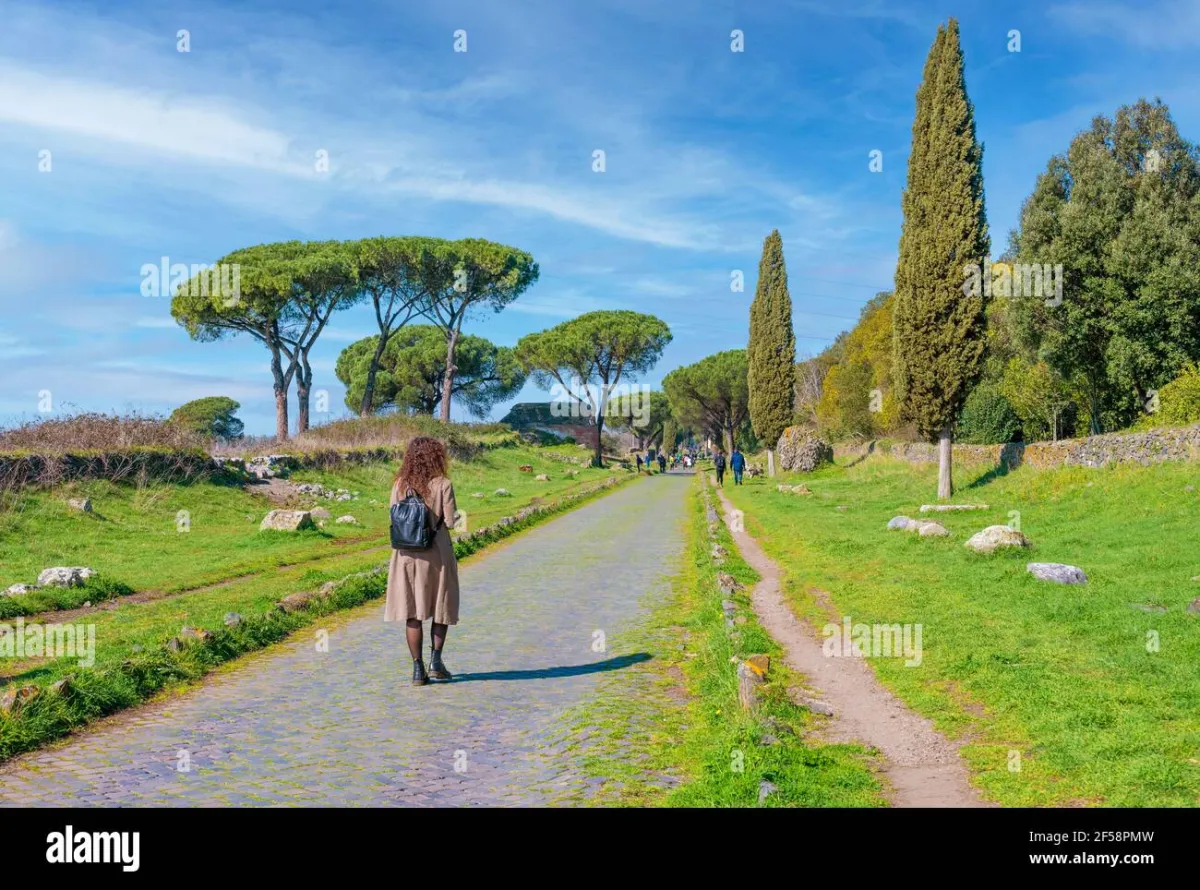 Photo: Via Appia, via c8.alamy.com
The Roman innkeeper's anxiety was legitimate. Inns were genuinely dangerous places — sites of robbery, disease, and the particular vulnerability that comes from sleeping deeply in an unfamiliar space among people whose intentions you cannot assess. The talisman was a form of communication across time: the host speaking to the guest before the guest arrived, making a promise that the premises had been spiritually secured. Whether the talisman actually worked was beside the point. The gesture of placing it there was the transaction.
The Medieval Pilgrim's Room and the Language of Sacred Objects
By the high medieval period, the infrastructure of Christian pilgrimage had produced an elaborate vocabulary of objects left for traveling strangers. Hospices operated by monastic orders placed crucifixes above beds, kept oil lamps burning through the night, and sometimes left small devotional cards — the era's equivalent of a welcome note — depicting the saint whose relics the pilgrim was presumably traveling to venerate. The object was simultaneously practical and theological: it reminded the exhausted traveler why they had undertaken the journey, reframing discomfort as spiritual merit.
What is striking, viewed across the distance of several centuries, is how precisely this mirrors the modern hotel's curated 'welcome amenity' — the handwritten card from the general manager, the locally sourced chocolate on the pillow, the QR code linking to a curated neighborhood guide. The content has been thoroughly secularized. The structure has not. A voice from the institution is still reaching forward in time to address a person not yet present, still attempting to shape the emotional register of the stranger's arrival before the stranger has crossed the threshold.
The Gideon Bible and the Geometry of American Anxiety
The Gideons did not invent the hotel Bible. They industrialized it. Their genius was recognizing that the American traveler of the early twentieth century occupied a specific psychological position: newly mobile, increasingly secular in practice if not in self-identification, and profoundly alone in ways that the older social architecture of travel — the coaching inn, the boarding house, the family friend's spare room — had never permitted. The railroad hotel and the commercial motor court delivered the traveler into a standardized solitude that had no real historical precedent.
The Bible in the drawer was a response to that solitude. It was the institution saying, in the most culturally legible language available to a broadly Protestant nation: you are not entirely alone here, and the terms of your aloneness have been acknowledged by someone who thought of you before you arrived. The fact that most guests never opened it was not a failure of the program. The knowledge that it existed was the program.
The Laminated Card and the Minibar Note: Secular Successors
Contemporary hotels have largely moved the Bible from the nightstand to the drawer, and in many properties, out of the room entirely. What has replaced it is a proliferation of laminated cards, branded notepads, and small printed notes that perform an identical psychological function through entirely different means. The card listing checkout procedures and wifi passwords. The note explaining the environmental linen policy. The minibar welcome letter describing the provenance of the locally sourced snacks. The curated reading list left by a boutique property's 'cultural director.'
Each of these objects is the current era's talisman — the host's attempt to speak across time to an unknown guest, to establish the moral and practical terms of the temporary relationship before it begins. The Roman innkeeper painted a snake above the door to say: this place is protected. The Gideon Society placed a Bible in the drawer to say: you are not spiritually abandoned. The boutique hotel leaves a handwritten note on recycled paper to say: we are thoughtful people and we hope you are too.
The anxiety behind each gesture is functionally identical. The stranger is unknown. The stranger's needs, character, and vulnerabilities cannot be predicted. The host cannot be present for every moment of the stay. Something must be left to stand in for the host's intentions — to communicate care, establish norms, and signal that the space has been prepared with the stranger's specific condition of strangeness in mind.
What the Talisman Reveals About the Era That Made It
For the traveler who pays attention to such things, the object left in the room is one of the more honest documents a culture produces. It is not composed for posterity or edited for official purposes. It is simply the best answer a given era could construct to a question that never changes: what does a person alone in an unfamiliar place most need to be told?
The Roman answer was: you are protected by forces older than this innkeeper. The medieval answer was: your suffering here has cosmic meaning. The early American answer was: the moral framework you left at home has followed you here. The contemporary answer, in its most refined boutique form, is: you are in the company of people who share your values and your aesthetic sensibility.
None of these answers is wrong. All of them are incomplete. And all of them will look, to travelers two centuries from now, exactly as revealing and exactly as poignant as the Gideon Bible looks to us today — a civilization's most sincere attempt to comfort the stranger, preserved in the amber of its own particular fears.