What You Brought to the Table: The Potluck as America's Oldest Peace Negotiation
What You Brought to the Table: The Potluck as America's Oldest Peace Negotiation
Long before diplomats drafted treaties or chambers of commerce printed welcome brochures, ordinary Americans were conducting sophisticated social negotiations one covered dish at a time. The communal meal where every guest arrives bearing food is not a quaint domestic ritual — it is a technology of trust as old as settled civilization, and Americans have been deploying it with surprising sophistication for three centuries without quite knowing what they were doing.
The traveler who understands this has a significant advantage. Because wherever the potluck tradition appears — in a church fellowship hall, on a suburban cul-de-sac, at a campground picnic table, or in the carefully assembled welcome basket of a short-term rental host — the same ancient negotiation is underway. And reading it correctly tells you more about a community than any guidebook ever will.
The Original Stakes
The word itself is older than the republic. "Potluck" entered the English language in the sixteenth century, describing the luck of whatever happened to be in the pot when an unannounced guest arrived. To offer someone potluck was to offer them your actual domestic reality — not a performance of abundance, but the honest contents of your kitchen. It was, by definition, a gesture of radical transparency.
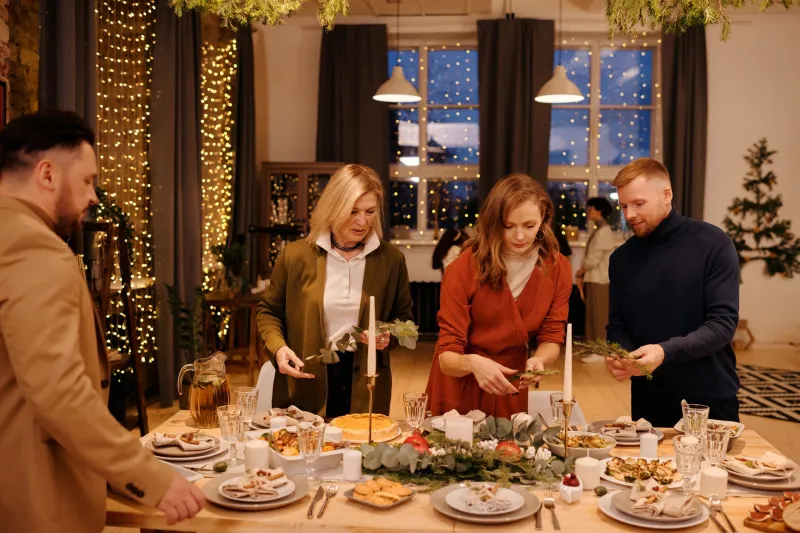
This matters because transparency is the precondition for trust, and trust is the precondition for cooperation among strangers. Anthropologists have documented communal food-sharing practices across virtually every human culture on record. The details vary enormously — the foods, the rituals, the hierarchies of who serves whom — but the underlying architecture is identical: I give you something I made, you receive it, and in that exchange we have established that neither of us intends the other harm. The meal is the treaty. The dish is the signature.
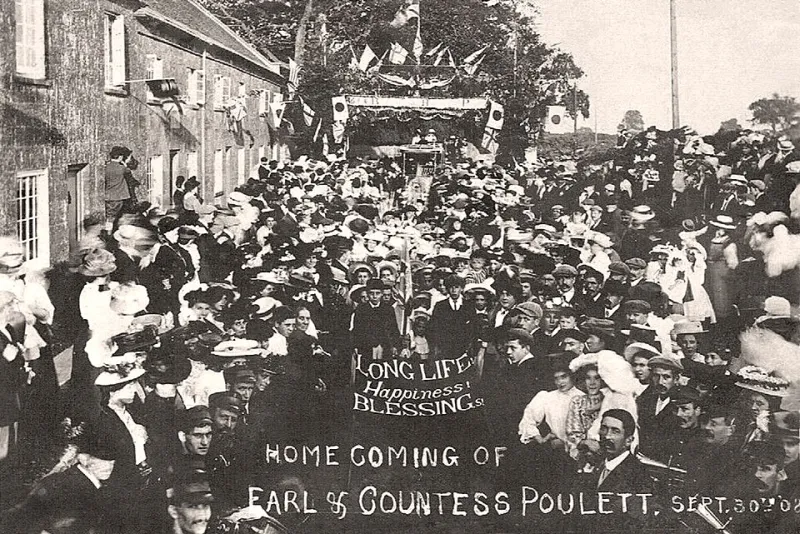
Frontier America understood this instinctively, even if it lacked the vocabulary to articulate it. When a new family arrived in a settlement, neighbors brought food. When a church congregation needed to integrate newcomers, it organized a dinner where everyone contributed. The logic was not primarily charitable — it was diplomatic. A stranger who has eaten your cooking is no longer entirely a stranger. They carry something of your household with them. The relationship has been initialized.
The Covered Dish as Social Document
What you bring to a potluck has always communicated something beyond the food itself. This is the dimension that modern participants tend to underestimate.
In nineteenth-century rural communities, the dish a family contributed to a church social or a barn-raising supper was a legible signal of their economic standing, their cultural origins, and their aspirations. A German immigrant family in Ohio brought what their grandmothers made in the Rhineland. A family newly arrived from the Virginia Tidewater carried the culinary grammar of a different social world. The table, taken as a whole, was a map of the community's composition — its tensions, its hierarchies, its points of negotiation.
 Photo: Virginia Tidewater, via image1.slideserve.com
This has not fundamentally changed. Contemporary food writers occasionally note, with some amusement, the unspoken anxiety that attends the modern potluck: What is the correct thing to bring? How elaborate should it be? Is a store-bought item acceptable? These questions feel trivial until you recognize them as the contemporary expression of a very old social calculation. You are not merely deciding what to cook. You are deciding how you wish to be perceived, how much effort you are willing to demonstrate, and what kind of relationship you are proposing with the people at that table.
The traveler who arrives in an unfamiliar American community and is invited to contribute to a communal meal has been handed an extraordinary instrument. What they bring, and how they present it, will be read. The reading will be largely unconscious on both sides, which makes it more reliable, not less.
From the Church Hall to the Welcome Basket
The potluck's most recent architectural evolution is the Airbnb welcome basket — that carefully curated collection of local honey, artisanal crackers, and handwritten notes that has become a signature gesture of the short-term rental era. Hosts who assemble these baskets tend to describe the impulse in terms of hospitality or marketing. Both explanations are accurate and both are incomplete.
What the welcome basket actually represents is the host's attempt to compress the potluck gesture into a one-directional form. The traveler cannot reciprocate in kind — they are, by definition, away from their own kitchen. So the host performs the entire negotiation unilaterally: I am giving you something I selected, something local, something that represents my world. I am asking nothing in return except that you receive it in the spirit offered.
This is hospitality stripped to its structural minimum, and it is recognizably the same gesture that a frontier neighbor performed when they carried a pot of stew to a newly arrived family's door. The technology has been updated. The psychology has not moved an inch.
What This Means for the Traveler
There is a practical implication buried in all of this history, and it is this: in communities where communal food traditions remain active, the traveler who finds a way to participate — genuinely, not performatively — gains access to a social layer that no amount of money or advance research can otherwise purchase.
This is not a recommendation to invite yourself to strangers' dinners. It is an observation about what to look for and how to interpret it when the invitation arrives. A community that still organizes itself around shared tables — whether those are church suppers, neighborhood block parties, farmers' market potlucks, or the informal food exchanges of tight-knit immigrant enclaves — is a community that has preserved one of the oldest and most reliable mechanisms for incorporating outsiders.
The traveler who understands the potluck as diplomacy rather than dinner will approach the invitation differently. They will bring something real. They will pay attention to what others bring. They will understand that the conversation happening over the food is, in some meaningful sense, secondary to the conversation the food itself is conducting.
America has been rehearsing this negotiation since before it had a name. The frontier is long closed, but the covered dish is still making its rounds, and it is still carrying the same ancient message: I come in good faith. Here is the proof.