The Living Use of the Dead: Why Americans Have Always Traveled to Stand Over Graves
On any given weekend, a visitor to Forest Lawn Memorial Park in Glendale, California, will encounter something that the park's founder, Hubert Eaton, designed with considerable deliberateness: tourists. Not mourners—or not only mourners—but people with cameras and maps, consulting printed guides to the final resting places of Clark Gable, Elizabeth Taylor, and Michael Jackson. They are not grieving. Most of them never met the people they have come to find. They are doing something older and stranger and more human than grief. They are using the dead to take the measure of their own lives.
This is not a modern peculiarity. It is not even an American one, though Americans have developed a particularly elaborate institutional infrastructure around it. The impulse to travel specifically to stand over the remains of the significant dead is documented across every culture that has left records, and it has operated on the same psychological mechanism for the full span of recorded history.
Human psychology has not changed in five thousand years. The graveyard tourist of 2024 and the medieval pilgrim walking to Canterbury are executing the same interior transaction by different exterior means.
The Pilgrimage Beneath the Pilgrimage
The European tradition of visiting the graves of saints—which is to say, visiting the physical remains of the significant dead—was the organizing principle of long-distance travel for the better part of a millennium. Canterbury, Santiago de Compostela, Rome: these were not primarily religious destinations in the way a church is a religious destination. They were geographic locations where the boundary between the living and the dead was understood to be thinner than usual. The traveler came not to worship an abstraction but to be physically proximate to a specific body.
The Protestant Reformation dismantled the theological framework but not the impulse. What followed, in the seventeenth and eighteenth centuries, was the rapid secularization of exactly the same behavior. The English began visiting Westminster Abbey not to pray over saints but to stand over poets. The Grand Tour routed young aristocrats through Rome not primarily for the churches but for the ruins—the physical residue of the magnificently dead. By the early nineteenth century, the graves of Byron, Keats, and Shelley in Rome's Protestant Cemetery had become standard stops on the itinerary of any serious traveler.
The theology had changed. The travel behavior had not moved an inch.
The American Adaptation
America arrived at this tradition with characteristic energy and without much of the European ecclesiastical scaffolding. The new republic had no saints, no ancient ruins, and no thousand-year-old cathedrals. What it had, almost immediately, was a powerful need to construct a usable past—and the graves of the Founding Fathers became, by default, the country's first pilgrimage sites.
Mount Vernon received paying visitors within a decade of Washington's death. Monticello, despite Jefferson's complicated legacy, drew travelers who needed to stand in the physical presence of the idea of the republic. These were not purely sentimental journeys. They were, for many visitors, genuinely clarifying ones. To stand at a grave is to be confronted with the arithmetic of a life: born this year, died this year, did these things in between. The headstone is a ledger, and the traveler reads it with the particular attention of someone who is also, eventually, going to need one.
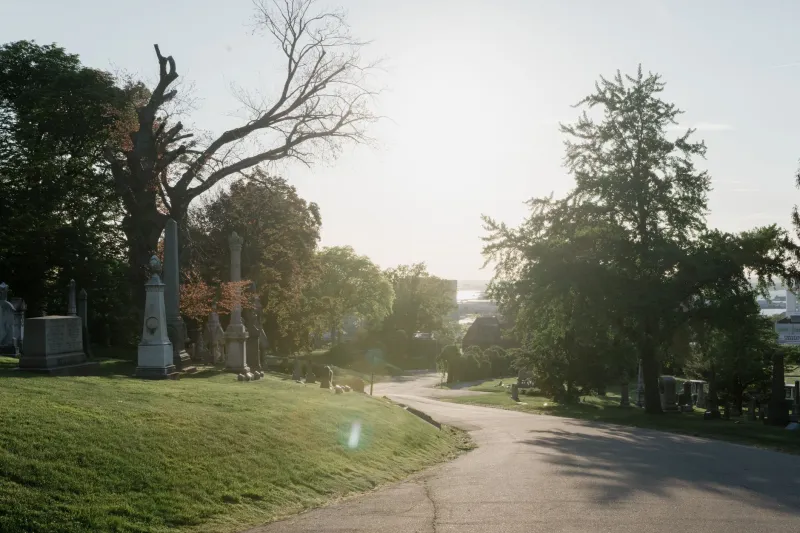
By the mid-nineteenth century, rural cemetery movements in Boston, Brooklyn, and Philadelphia had transformed burial grounds from purely functional spaces into designed landscapes—places that explicitly invited the living to walk, reflect, and linger. Mount Auburn Cemetery in Cambridge, Massachusetts, opened in 1831 and was immediately one of the most visited destinations in New England. People came from considerable distances to stroll among the graves. They brought picnics. They brought children. They were not being disrespectful. They were doing exactly what the designers intended: using the organized presence of the dead to think about the organization of their own living.
The Rubbing and the Root
Two practices that emerged in American graveyard tourism are worth examining in detail, because each reveals a slightly different facet of the same underlying psychology.
Gravestone rubbing—placing paper over an inscribed stone and transferring the image with charcoal or crayon—became a popular American pastime in the 1960s and 1970s. On the surface, it looks like a craft project. Beneath the surface, it is an act of rescue. The traveler is pulling a name and a date back from the erosion that is slowly reclaiming it. The rubbing is a stay of execution against forgetting. That the traveler typically has no personal connection to the person named on the stone is, psychologically, beside the point. The act of preservation is its own reward—it answers the traveler's private anxiety about being forgotten by performing the opposite of forgetting for someone else.
Genealogy tourism operates on a more personal register but the same emotional frequency. The American who travels to a small churchyard in County Cork or a Lutheran cemetery in rural Pennsylvania to find an ancestor's grave is not simply completing a research project. They are doing something that no digital database can replicate: they are standing in the place where the chain of causation that produced them is physically anchored. The grave says: this person existed in this specific ground, and because they did, you exist now, and you are standing here. It is one of the few travel experiences that is genuinely irreducible—that cannot be approximated by a photograph or a website or a virtual tour.
The Economics of Famous Death
The commercial infrastructure that has grown up around American graveyard tourism is considerable, and it is worth taking seriously as evidence of the behavior's depth and durability.
Graceland's Meditation Garden, where Elvis Presley is buried alongside members of his family, receives roughly half a million visitors per year. The grave itself—not the house, not the car collection, not the jumpsuit display—is for many visitors the primary destination. The National Cemetery system, which includes Arlington, receives millions of visitors annually, many of them with no personal connection to anyone interred there. The Gettysburg National Cemetery is one of the most visited sites in Pennsylvania, and its draw is not the military history alone but the particular gravity of seventeen thousand marked graves on the ground where the men died.
What these sites sell, when they sell anything, is proximity to consequence. The traveler who stands at the Tomb of the Unknown Soldier is not purchasing entertainment. They are purchasing a few minutes of enforced seriousness—a structured occasion to think about sacrifice, mortality, and the particular weight of a life spent in a particular way. In a culture that provides very few formal occasions for this kind of reflection, the graveyard visit fills a genuine need.
What the Headstone Teaches
The oldest travel writing in the Western tradition is full of graveyard visits. Herodotus recorded burial customs with the same careful attention he gave to battle tactics and trade routes. He understood, as every serious student of human behavior eventually understands, that the way a culture treats its dead tells you almost everything about how it treats its living.
The American traveler who seeks out a grave—whether it belongs to a celebrity, a president, an ancestor, or an anonymous soldier—is participating in this long tradition of reading. The headstone is a compressed biography, and the act of reading it in person, in the physical place where the body lies, is meaningfully different from reading the same information in a book or on a screen.
The difference is the one that has always made travel necessary: you have to be there. The ground has weight. The stone has texture. The dates have, in that specific place, a finality that no digital reproduction can fully convey.
The traveler comes to the grave to learn something that cannot be learned any other way. They learn it standing up, in the open air, with their own mortality in their peripheral vision. And then they get back in the car and drive to wherever they are going next, carrying the lesson with them, which is exactly what the living are supposed to do with what the dead leave behind.