The Privilege of Being Nobody: How the Traveler's Anonymous Room Became Civilization's Most Enduring Luxury
The Privilege of Being Nobody: How the Traveler's Anonymous Room Became Civilization's Most Enduring Luxury
The contemporary hospitality industry has spent the better part of two decades persuading travelers that what they most desire is authentic local connection — a room that feels like a home, a host who knows the neighborhood, an experience indistinguishable from actually living somewhere. The boutique hotel, the curated inn, the host who leaves hand-written notes and locally sourced jam — all of it is premised on the assumption that anonymity is a deficiency to be corrected.
The historical record disagrees, rather forcefully.
For most of human history, the traveler's room has been valued not for what it offered but for what it withheld: knowledge of who you were before you arrived. The room that remembered no one was not a failure of hospitality. It was hospitality's highest achievement.
The Mesopotamian Waystation and the Logic of the Clean Slate
The earliest dedicated traveler's accommodations in the archaeological record — waystation structures along the trade routes of ancient Mesopotamia, dating to roughly 2000 BCE — were not designed to make the traveler feel at home. They were designed to make the traveler feel nowhere in particular. A bed, a roof, food at a predictable price, and the company of strangers who would be gone by morning. The merchant who stopped there was, for the duration of his stay, simply a traveler. Not a debtor, not a rival, not a member of a particular family or guild or city. Simply a person who needed to sleep before continuing.
This was not accidental. The waystation's commercial logic depended on it. A facility that required its guests to present credentials, explain their origins, or justify their presence would have been commercially useless. The anonymity was the product.
The Roman Mansio: Official Anonymity
The Roman Empire, which understood infrastructure as a form of political power, built the mansio system specifically to move authorized travelers — military couriers, imperial officials, provincial administrators — along its road network with maximum efficiency. The mansio was not a social institution. It was a logistical one. You presented your diplomatic pass, you were given a room, you slept, you departed. No one asked about your family in Gaul or your property dispute in Carthage.
What is striking, in retrospect, is how quickly this official anonymity became desirable in its own right. Private travelers who could afford the cost began seeking out mansiones precisely because the alternative — the private hospitium, where you were the guest of a host who expected conversation, reciprocity, and an accounting of your circumstances — was socially exhausting. The mansio asked nothing except payment. That asking-of-nothing had a price, and people paid it.
The traveler paying a premium for a hotel room in order to avoid the social obligations of a friend's guest bedroom is performing the same calculation that a Roman merchant performed two thousand years ago. The math has not changed.
The American Tavern and the Politics of the Common Room
Early American travel accommodations present a more complicated picture, because the tavern system was simultaneously a social institution and a commercial one. The common room was genuinely common — travelers of varying status and origin shared space, shared meals, and were expected to share conversation. But the sleeping arrangements, particularly as the nineteenth century progressed and American hotels began to distinguish themselves from their European predecessors, moved steadily toward privacy.
The private room — which American hotels pioneered as a standard offering rather than a luxury exception — was, from the beginning, a statement about the traveler's right to be temporarily unaccountable. You were not, in your private room, someone's neighbor, someone's creditor, someone's estranged relative. You were a paying guest, and the transaction ended there.
This was, as the historian A.K. Sandoval-Strausz has argued, a genuinely democratic innovation — but its democracy was not the democracy of shared space. It was the democracy of equal access to solitude. Anyone who could pay the rate could purchase the same quality of anonymity.
The Motel Strip and the Architecture of Disappearance
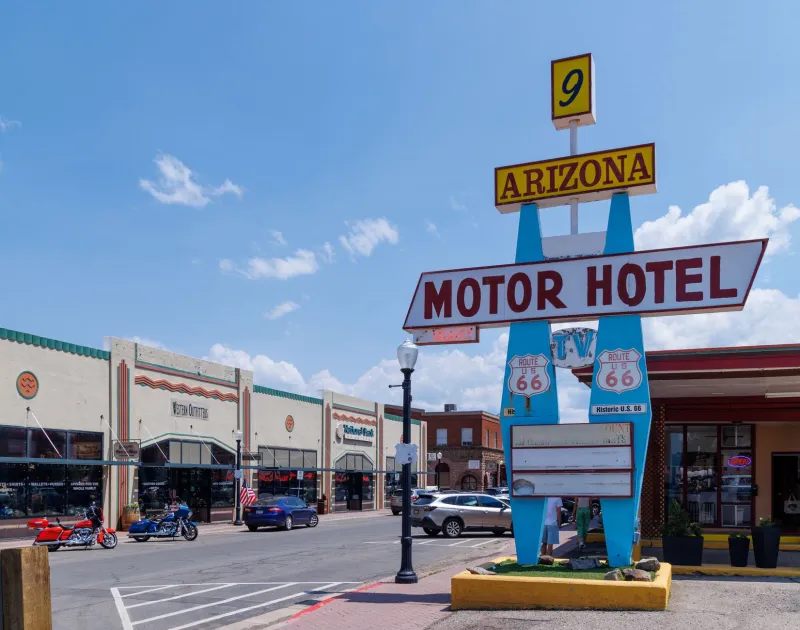
The American motel, which proliferated along the highway system from the 1920s onward and reached its cultural apex in the postwar decades, represented the logical extreme of this tradition. The motel's entire design philosophy was premised on minimizing the social transaction between traveler and establishment. You drove in, you registered with a name that no one verified, you parked directly outside your door, and you left in the morning without speaking to another human being if you preferred not to.
The motel was, and remains, the most efficient anonymity-delivery mechanism in the history of American travel. It is not coincidental that it became, simultaneously, the preferred accommodation of traveling salesmen, couples conducting affairs, fugitives, and anyone else for whom the temporary suspension of their known identity was not merely pleasant but necessary.
The motel strip has been much maligned — as ugly, as soulless, as the antithesis of authentic travel experience. But its critics tend to miss what its patrons understood intuitively: the soul it lacked was precisely the soul its guests were paying to escape.
What Boutique Hotels Are Actually Selling
The boutique hotel movement, which positioned itself explicitly against the anonymity of the chain property, promised travelers the opposite of the motel: a room with a personality, a staff who remembered your preferences, a building with a history that would become part of your own. This was a genuine and often successful commercial proposition. Many travelers genuinely want what boutique hotels offer.
But it is worth noting that the boutique hotel has not eliminated the market for anonymity — it has simply redefined where that market sits on the price curve. The large chain property, which the boutique hotel positioned itself against, retained its clientele precisely because that clientele valued consistency and invisibility over character and engagement. The traveler who checks into a Marriott in an unfamiliar city and finds every detail exactly as expected is not experiencing a failure of imagination. She is experiencing the deliberate, competently delivered promise of a room that will ask nothing of her.
The anonymous room has simply become the mid-market option rather than the premium one. The underlying desire it serves is unchanged.
The Oldest Reason to Leave Home
What the long history of the traveler's anonymous room reveals is a motivation for travel that rarely appears in the marketing materials: the desire to be, temporarily, unknown. Not to discover a new place. Not to collect experiences. Not to return transformed. Simply to exist, for a defined period, outside the web of obligations, histories, and identities that constitute ordinary social life.
The Roman merchant in his mansio, the frontier traveler in his tavern room, the salesman in his highway motel — all of them were purchasing the same thing. A night, or several nights, in which the accumulated weight of being a specific person in a specific place with specific responsibilities could be set aside.
This is not escapism in the pejorative sense. It is a legitimate and recurring human need, documented across every culture and every era that has left records of how its travelers lived. The room that remembers no one has always been, for a certain kind of traveler in a certain kind of moment, the most honest room in the building.
Understanding this changes how we think about where we stay. The question is not only what a property offers but what it withholds — and whether what it withholds is, in fact, exactly what you came to leave behind.