The Road That Ran Out of Believers: What Abandoned American Corridors Left Behind
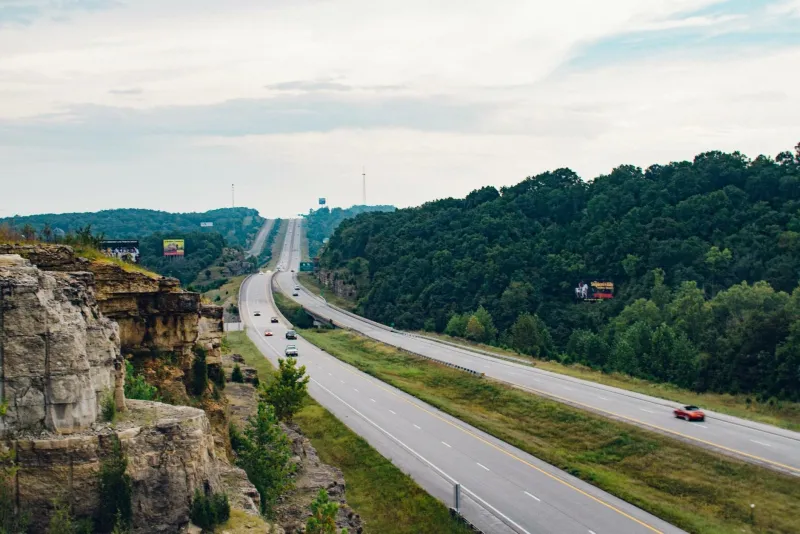
The asphalt still exists in places. You can find it if you know where to look—a lane and a half of crumbling pavement disappearing into overgrowth along a ridgeline in eastern Tennessee, or a concrete slab highway running arrow-straight through the Nebraska sandhills before terminating, without ceremony, at a fence line. No sign marks the end. No historical marker explains what this road once connected, or why it no longer does.
These are not forgotten roads. They are abandoned ones. The distinction is important. A forgotten road was simply overtaken by time. An abandoned road was a decision—a moment when a state legislature, a federal agency, or a railroad board looked at what had been built, considered what it would cost to maintain, and chose differently. The road did not fail. It was failed. And the nature of that failure is one of the more honest records we have of American priorities across the past century.
What a Road Is, Before It Is a Road
Every transportation corridor begins as an argument. Someone—a booster, an engineer, a senator with constituents to serve—makes the case that connecting two points will produce value sufficient to justify the cost. That argument is always, at its core, a prediction about the future: about where people will want to go, how frequently they will want to go there, and what the act of going will be worth to them.
The historical record of American infrastructure is, in large part, a record of how those predictions fared. Some were vindicated spectacularly. The transcontinental railroad, completed in 1869, exceeded nearly every projection made for it. The Interstate Highway System, begun in the 1950s, restructured the country in ways that its architects anticipated and in ways they could not have foreseen. These are the corridors that get written about.
The abandoned ones rarely do. But they made the same argument. They were built on the same optimism. And the towns that grew up along them—that platted their streets, named their main avenues, and built their courthouses in confident expectation of traffic that would arrive and keep arriving—were not naive. They were reading the same signals that the successful towns read. They simply happened to be on the wrong side of a decision that was made, in many cases, for reasons that had nothing to do with their merits.
The Scenic Byway Problem
Among the most instructive categories of abandoned American corridor is the scenic byway—roads built or designated specifically to move travelers through landscapes of acknowledged beauty, at speeds that would permit the beauty to register. The history of these roads is a compressed version of a larger American argument about what travel is supposed to accomplish.
In the early decades of automobile travel, the scenic route was not the consolation prize. It was the point. Organizations like the Lincoln Highway Association and the various state boosters who promoted routes through the Ozarks, the Blue Ridge, and the California coast understood that the journey itself was a destination—that the road through the mountains was not a slower alternative to a faster road through the valley, but a fundamentally different proposition.
That proposition lost. Not immediately, and not everywhere, but consistently enough that the landscape is now dotted with the remnants of roads that were built on the assumption that Americans would choose beauty over efficiency when given the option. Town records from communities along decommissioned scenic routes in the Appalachians and the Ozarks document the moment of recognition with particular clarity. The entries in county commissioner minutes from the late 1950s and early 1960s read, in many cases, like correspondence from people who cannot quite believe what they are watching happen. The new highway is going where? Through the bottom of the valley? But that route passes nothing.
It passed something. It passed faster. That was sufficient.
The Towns the Corridor Left Behind
Longtime residents of communities bypassed by mid-century highway realignments describe the experience in terms that have remained consistent across decades of interviews and oral history projects. The language is almost always that of sudden invisibility. One day the road came through town. The next—not immediately, but soon enough—it did not. The traffic that had made the filling station, the diner, the motor court economically viable simply ceased to arrive.
What is historically significant about these accounts is not the economic disruption, though that was real and lasting. It is the speed with which the physical corridor itself began to revert. Roads that had been maintained by traffic—packed down, marked, kept clear—began within a few years to show the signs of abandonment. Vegetation encroached. The pavement cracked. The shoulders softened. Nature's indifference to human infrastructure is, in historical terms, remarkably swift.
The towns themselves proved more durable, though not always by much. Some survived by finding alternative economic identities. Others contracted slowly into something smaller than they had planned to be, maintaining their courthouses and their grid-patterned streets as a kind of architectural memory of a larger ambition. Walking through one of these communities today—and there are hundreds of them scattered across the American interior—is to walk through a built argument that was made and lost. The wide main street, the oversized hotel, the commercial blocks designed for a volume of foot traffic that never materialized: these are the physical record of a prediction that did not come true.
What the Abandonment Chose
The Interstate Highway System, for all its genuine achievements, was also a massive act of selection. It chose some routes over others, some towns over others, some modes of experiencing the American landscape over others. The choices were made on grounds that were, at the time, considered self-evidently rational: efficiency, capacity, national defense. The case against those grounds—that the scenic route through the mountains was worth preserving not despite its slowness but because of it—was made repeatedly and lost repeatedly.
That loss was not inevitable. Other countries, facing equivalent infrastructure decisions in the same period, made different choices—maintaining passenger rail networks, preserving coastal roads, keeping mountain passes open to travelers who were not in a hurry. The American choice was not the only available choice. It was a choice, made with characteristic confidence, in favor of speed and scale over texture and connection.
The abandoned corridors that remain are the evidence of what that choice cost. They are not ruins in the classical sense—they carry no grandeur, no patina of civilization's long arc. They are simply roads that ran out of believers before they ran out of pavement. Standing at the end of one, where the asphalt dissolves into gravel and the gravel into grass, it is possible to feel, with unusual precision, the weight of a decision made by people who are now dead about a future they could not fully see.
They could not have known what they were choosing to lose. But the road knows. It has been keeping the record.