Sealed at the Border: The Honest Psychology of Souvenirs We Never Open
Let us begin with an inventory, because the inventory is the confession.
In the average American home that belongs to someone who travels with any regularity, there exists a class of objects that occupies a specific kind of limbo. They are not decorative—they are rarely displayed. They are not functional—they are rarely used. They are not sentimental in the way that photographs are sentimental, because they are not looked at. They sit in drawers, on pantry shelves, at the back of closets, still in their original packaging, still bearing their price tags, still smelling faintly of the shop where they were purchased. They are the sealed souvenirs: the jam that was never spread, the local hot sauce that never touched food, the artisan soap that outlasted three bars of the traveler's regular brand without being unwrapped.
The standard interpretation of this phenomenon is embarrassing and dismissive: we bought things we didn't need and now we feel vaguely guilty about it. This interpretation is not wrong, but it is incomplete in ways that five thousand years of travel culture can help correct.
What the Romans Brought Home from Greece
The Roman habit of collecting Greek objects—sculpture, pottery, textiles, and decorative items of every conceivable variety—was so pronounced that it generated its own satirical literature. Horace, Juvenal, and Pliny all found material in the Roman tourist's compulsion to acquire the culture he had just visited, often without the discriminating knowledge to understand what he was acquiring. Roman villas filled with Greek objects that their owners could not accurately identify or contextually place. The objects were not purchased for use. They were purchased as evidence.
Evidence of what? Of having been there. Of having been, for a moment, in proximity to something the purchaser recognized as valuable even if he could not fully articulate why. The Greek vase sitting in a Roman atrium that no one could date or attribute was not a failure of connoisseurship. It was a successful transaction of a different kind: the buyer had converted an experience into a portable object, and the object's primary function was to prove the experience had occurred.
This is the mechanism that produces the unopened jar of Vermont maple syrup. The syrup is not food. The syrup is a certificate.
The Purchase as Negotiation
To understand why the certificate so frequently goes uncashed, it helps to examine what the traveler was actually negotiating at the moment of purchase.
The souvenir shop transaction is one of the most psychologically dense moments in the travel experience, and it receives almost no serious attention. The traveler is typically near the end of a visit, which means she is beginning the cognitive process of leaving. She is aware, often acutely, of the gap between what she hoped the trip would do for her and what it actually did. She is aware that she is about to return to a life that the trip has not, in fact, transformed. And she is standing in front of a shelf of objects that seem to promise, at a price point ranging from four to forty dollars, that she can carry some portion of the place back with her.
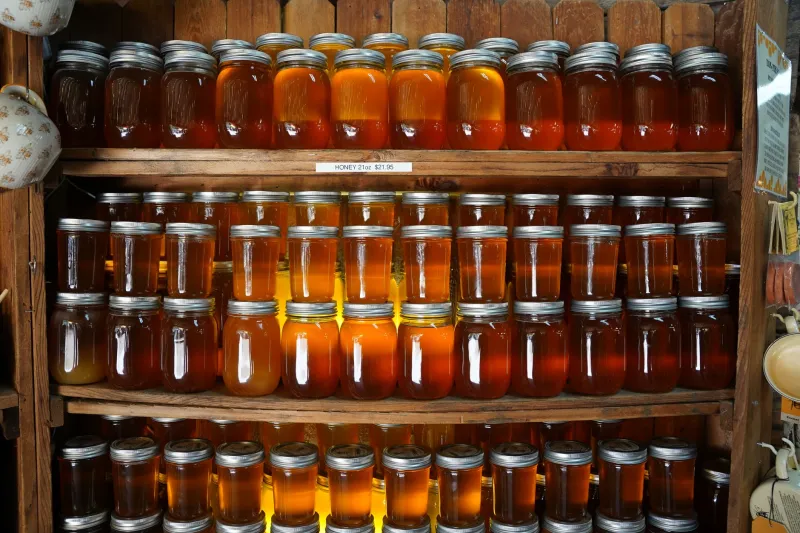
The purchase is not irrational. It is a hedge against the loss she is already anticipating. The local honey is purchased not because she needs honey but because she needs to believe that the place she is leaving will continue to exist in her life after she has left it. The object is the promise.
The object goes unused because promises made under emotional pressure are often structurally incompatible with ordinary life. The Vermont maple syrup sits sealed because opening it and pouring it on pancakes on a Tuesday morning in suburban Ohio would not, in fact, recreate the feeling of being in Vermont. The traveler knows this, somewhere below the level of conscious articulation. And so the jar stays sealed, preserving the possibility of the feeling rather than risking its definitive absence.
The Guidebook That Never Left the Bag
A specific subcategory of the sealed souvenir deserves its own examination: the travel guidebook purchased at the destination and never consulted there.
This object is particularly revealing because its uselessness is immediate and total. The traveler buys a guidebook to New Orleans on her second-to-last day in New Orleans. She will not read it in New Orleans—there is no time. She will not read it at home, because by the time she arrives home the trip is over and the guidebook's practical information has already expired. She knows all of this at the moment of purchase. She buys it anyway.
What she is buying is not information. She is buying the identity of the kind of person who reads guidebooks about New Orleans—the thorough traveler, the intellectually curious visitor, the person who goes deeper than the surface. The guidebook is not a tool. It is a credential, purchased to retroactively certify a version of the trip that was more engaged, more thoughtful, and more prepared than the trip she actually took.
This is not a modern pathology. The medieval pilgrim purchased religious objects at shrine gift stalls that he would never use liturgically. The Grand Tour traveler bought prints of paintings he had seen for thirty seconds in a crowded gallery. The nineteenth-century American tourist at Niagara Falls purchased stereoscope cards of views he had just witnessed with his own eyes. In every case, the object was purchased not to extend the experience but to authorize it—to produce evidence that the traveler had been adequate to the occasion.
What the Sealed Jar Actually Contains
There is something worth honoring in the sealed souvenir, even as we diagnose it clearly.
The traveler who bought the jam and never opened it did want to be changed by travel. The purchase was a record of that desire, made at the moment when the desire was most acute. The object sitting on the pantry shelf is not evidence of failure. It is evidence of aspiration—specifically, the aspiration to be the kind of person for whom a place continues to matter after the departure gate closes.
The most honest thing a traveler can do with this knowledge is not to stop buying souvenirs but to read them more carefully. The objects you purchase and never use are a more accurate record of what you wanted from a trip than the photographs you took or the restaurants you reviewed. They are the inventory of your intentions.
And intentions, even unfulfilled ones, are worth knowing. The sealed jar tells you what you were hoping for. That is not nothing. That is, in fact, the beginning of understanding what you should be looking for on the next trip—before you arrive, rather than in the last twenty minutes before departure, standing in a shop, negotiating with a shelf.