The Useful Error: On Getting Lost and What We Surrendered When We Stopped
In the summer of 1849, a party of emigrants bound for California took a wrong turn in the Nevada desert and spent the better part of three weeks wandering a valley they had not intended to enter. They named it Death Valley, which suggests the experience was not pleasant. But one member of the party, a man named William Manly, later wrote that those weeks of disoriented wandering produced a more precise understanding of the desert's geography than any map then in existence could have provided. He had not found what he was looking for. He had found something more accurate.
This is the paradox at the center of accidental discovery: the wrong direction sometimes leads to a more complete picture of the territory than the right one would have. It is a paradox that GPS has, for most practical purposes, made irrelevant. And the loss is worth examining with some care.
What the Map Could Never Show
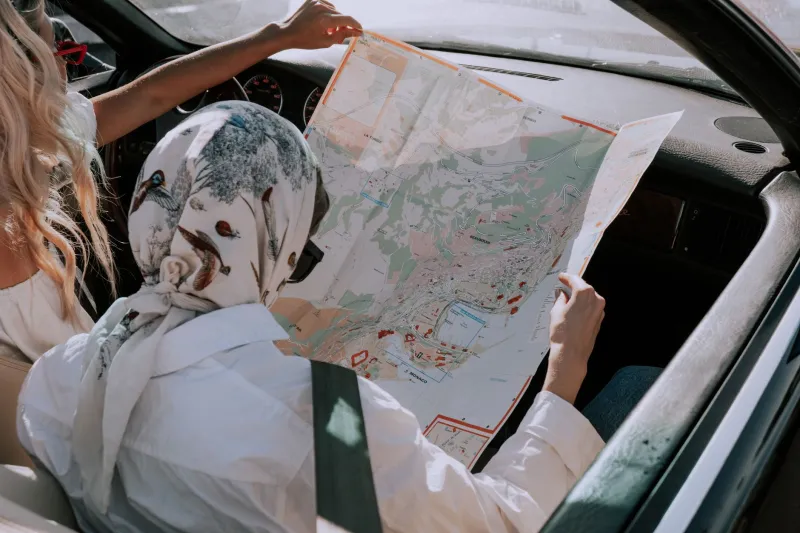
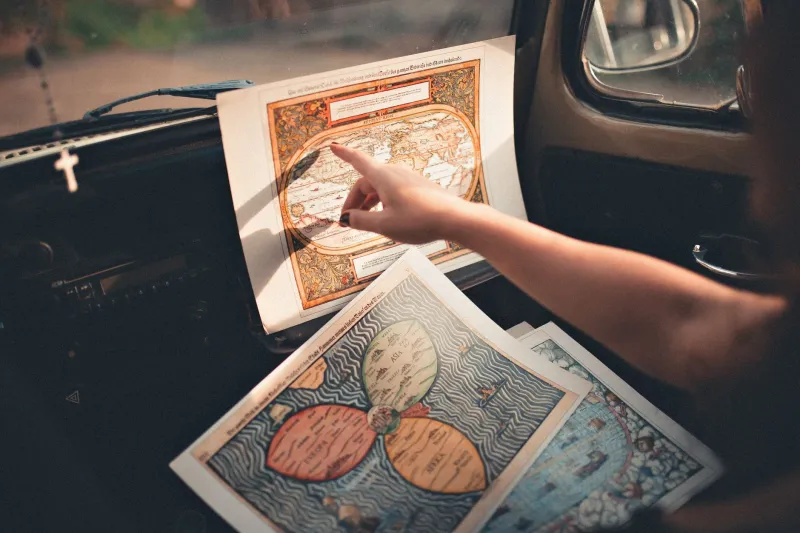
Cartography is, by definition, a record of what was already known at the time of its making. Every map is a historical document before the ink is dry. The traveler using a map is navigating by the past — by someone else's prior knowledge of a landscape that has, in the interval between survey and use, continued to change.
American travelers understood this intuitively for most of the country's history. The maps available to westward emigrants in the 1840s were partial, speculative, and frequently wrong in ways that mattered enormously. The maps available to Route 66 motorists in the 1930s were more complete but still subject to the reality that roads washed out, towns moved, and the distance between two points on a printed page bore an uncertain relationship to the distance between those same points on the actual ground.
Navigation under these conditions required a different cognitive posture than navigation by GPS. It required the traveler to hold his intended route loosely — to remain alert to the possibility that the road ahead might not behave as the map suggested, and to treat deviation not as failure but as data. The traveler who got lost and found his way back knew something about the landscape that the traveler who followed the correct route without incident did not.
The Gold Rush and the Productive Wrong Turn
The discovery of gold at Sutter's Mill in 1848 was itself an accident. James Marshall was not looking for gold. He was inspecting a millrace. The entire California Gold Rush — the largest mass migration in American history to that point, the event that effectively settled the Pacific Coast — originated in a misdirected glance.
What followed was an extended lesson in the value of going the wrong way. The prospectors who found the richest deposits were rarely the ones who followed established routes to known locations. They were the ones who went up the wrong creek, camped in the wrong canyon, and noticed something glinting in the gravel that they had not expected to see. The methodology of gold prospecting was, at its core, a systematic exploration of error.
This is not a coincidence. It reflects something durable about the relationship between discovery and disorientation. The traveler who knows exactly where he is going is, by definition, not going anywhere new. He is confirming a prior expectation. Discovery requires the prior expectation to fail.
Route 66 and the Theology of Wandering
By the mid-20th century, getting lost had acquired a romantic dimension that it had not previously possessed. The automobile gave Americans a new relationship with the road — one in which the journey itself, rather than the destination, became the primary object of attention. Route 66, which ran from Chicago to Santa Monica across 2,400 miles of American geography, was less a route than an invitation to deviate from one.
The writers and travelers who mythologized the road in the postwar decades were not celebrating efficient navigation. They were celebrating the wrong turn. The diner discovered by accident at mile marker 340. The motel recommended by a gas station attendant whose name was never learned. The town that appeared on no map the traveler carried but proved, upon arrival, to be exactly the kind of place that justified the entire trip.
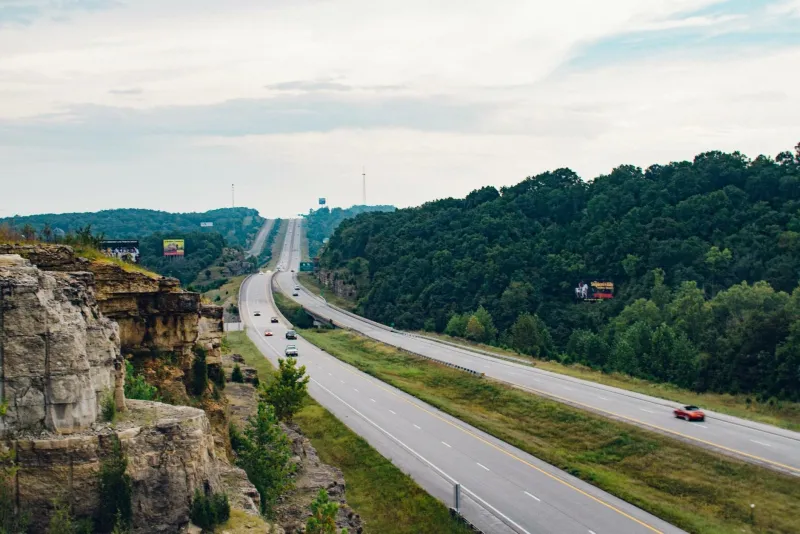
John Steinbeck, traveling the country for what became Travels with Charley, described his deliberate policy of avoiding the Interstate Highway System in favor of smaller roads where the unexpected remained possible. He understood that the faster road was also the emptier one — that efficiency and discovery were, in some fundamental sense, opposed.
The Blue Dot and Its Costs
The GPS navigation system did not merely improve the traveler's ability to reach his destination. It restructured his relationship to the space between departure and arrival.
Before the blue dot, the traveler occupied a condition of partial uncertainty at almost every moment of his journey. He knew, roughly, where he was. He knew, approximately, which direction he needed to go. But the territory between his current position and his intended destination remained genuinely open — full of roads he had not taken, towns he had not noticed, and possibilities that existed only because he had not yet foreclosed them.
The blue dot forecloses them in advance. The route is calculated before departure. Deviations are immediately corrected. The traveler moves through the landscape as though on a track — aware of the territory around him but not genuinely inside it, because genuine immersion requires the possibility of being surprised by where you are.
The consequences are not trivial. Research on spatial cognition suggests that GPS navigation reduces the formation of cognitive maps — the internal representations of geography that the brain constructs through active wayfinding. The traveler who navigates by GPS arrives at his destination but may retain less understanding of how he got there, and less knowledge of the surrounding territory, than the traveler who found his own way. He has outsourced the geography to a device, and the device has kept it.
What Getting Lost Actually Required
It is worth being honest about what the romantic account of getting lost tends to omit. Getting lost was frequently unpleasant. It was sometimes dangerous. The Death Valley party suffered severely. Countless emigrants who took wrong turns on the westward trails did not produce useful geographical knowledge — they produced tragedy.
The argument for productive disorientation is not an argument against safety. It is an argument for a middle condition — a state of navigation that is informed but not fully determined, that knows the general direction without having pre-solved every turn.
This condition is increasingly difficult to occupy. The architecture of modern travel — the GPS, the review platform, the curated itinerary — is designed to eliminate uncertainty at every stage. And uncertainty, for all its costs, was the precondition of discovery.
The Gold Rush prospector did not know which creek would yield color. The Route 66 traveler did not know which exit would produce the best meal of his life. The uncertainty was not incidental to the experience. It was the experience — the mechanism by which the journey remained genuinely open to what it might become.
The blue dot knows where you are at all times. That is its purpose, and it serves that purpose well. But the traveler who always knows exactly where he is has, in a meaningful sense, already arrived — and arrived, perhaps, somewhere slightly smaller than the place he set out to find.