Where You Turned Off the Highway: The Road Trip as an Unscheduled Autobiography
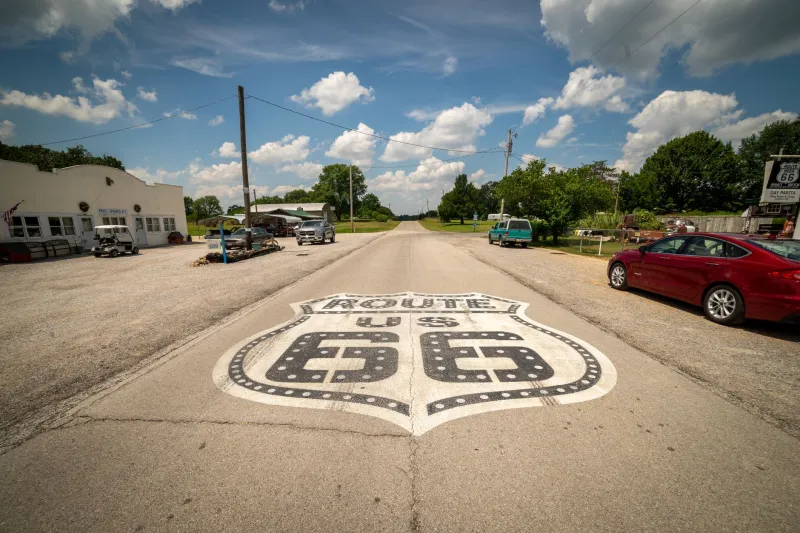
Consider the exit you almost didn't take.
You were making good time. The destination was two hours ahead. The sign appeared—a hand-lettered board, or a brown National Forest marker, or a roadside attraction placard promising something implausible—and you slowed without fully deciding to, and then you turned, and then you spent ninety minutes somewhere that was never on the itinerary and that you will, if pressed, admit was among the better parts of the trip.
This is not a coincidence. It is not luck. It is, read with the attention it deserves, a confession—one that the planning phase of the trip was specifically structured to prevent you from making.
The Itinerary as a Form of Self-Censorship
Human beings have been planning journeys and then deviating from those plans for as long as journeys have been recorded. The deviation is not a failure of the plan. It is the plan encountering the actual person who made it.
The travel plan is produced under conditions of optimism and abstraction. You are at home, you are rested, and you are constructing a version of yourself that is organized, efficient, and clear about what it wants. The plan reflects the traveler you intend to be. The detour reflects the traveler you are.
William Least Heat-Moon, whose 1982 account of driving the blue highways of rural America remains one of the most precise documents of unscheduled American travel, was explicit about this dynamic. He did not set out with a detailed itinerary. He set out with a directive to himself: avoid the interstates, follow the roads that seemed to go nowhere obvious, stop when something was worth stopping for. The resulting journey was not structureless. It was structured by instinct rather than advance decision, and the difference produced a record of the country—and of the traveler—that no planned route could have generated.
The blue highway is not a metaphor. It is a methodology. And it is one that travelers have employed, consciously or otherwise, throughout the history of overland movement.
What GPS Knows That You Don't
The aggregated navigation data produced by modern GPS systems contains, inadvertently, one of the most comprehensive records of human desire ever assembled. When researchers examine the difference between the routes people plan and the routes people actually drive, a consistent pattern emerges: the deviations cluster around food, water, natural features, and unexpected commercial attractions—in that order, and with a frequency that suggests the deviations are not random.
This is the same clustering that appears in medieval pilgrimage accounts, in the journals of nineteenth-century overland emigrants, and in the roadside diaries of early automobile tourists. The categories of the unplanned stop have remained essentially constant across centuries of travel culture: something to eat, something to look at, something that promises a story. The technology has changed. The appetite has not.
What GPS data adds to this picture is scale and granularity. We can now observe, at a population level, that the spontaneous exit from a major highway toward a smaller road increases significantly in the mid-afternoon—the point at which the original estimate of arrival time begins to feel like a constraint rather than a convenience. We can observe that detours toward water (rivers, lakes, coastline) occur at rates disproportionate to those features' proximity to major routes, suggesting that travelers are actively seeking them out rather than simply passing by. We can observe that the unscheduled stop at a roadside food stand or local diner produces, on average, a longer total deviation than the traveler initially intended when she first slowed down.
None of this is surprising if you have read enough travel journals. All of it confirms what the historical record has always suggested: the traveler's stated destination is the destination she told herself she wanted. The actual route is a more complete account.
The Productive Wrong Turn
There is a specific category of road trip deviation that deserves particular attention: the wrong turn that the traveler does not immediately correct.
Navigation errors are, in the age of real-time GPS guidance, almost entirely elective. The traveler who turns the wrong way at an intersection and then continues in that direction for several miles before correcting has made a choice, even if she would not describe it that way. She has, at the moment of error, assessed the wrongness of the turn and decided that something about the wrong direction was preferable to an immediate correction. The wrong direction may have been prettier. It may have passed through a town she found interesting. It may simply have offered a few additional minutes of not arriving.
That last possibility is worth dwelling on. The traveler who extends a wrong turn is often, at some level, negotiating with the destination. Arrival ends the journey, and the journey—even a journey that has been tiring, or uncomfortable, or imperfectly executed—contains a freedom that the destination does not. The open road, whatever its inconveniences, does not require you to unpack, check in, manage expectations, or resume being whoever you are when you are not traveling.
The extended wrong turn is sometimes a vote against arrival. And a vote against arrival is, if you follow the logic, a vote about something larger: the life you are returning to, the obligations waiting at home, the question of whether the person who left on this trip is the same person who should be going back.
Reading the Route You Actually Drove
If you have taken a significant road trip, there is a useful exercise available to you. Obtain a map—paper is better for this purpose than digital, because it allows you to see the whole at once—and trace the route you actually drove, including every deviation, every unplanned stop, every wrong turn you didn't immediately correct. Then trace, in a different color, the route you planned.
The gap between the two lines is a document. It records what you were drawn to when no one was holding you to the itinerary. It records what you slowed for, what you turned toward, what you couldn't pass without stopping. It records, with a precision that no journal entry or photograph can match, the texture of your actual preferences as opposed to your stated ones.
Travelers throughout history have produced this document without knowing they were producing it. The overland emigrants of the 1840s who veered toward hot springs not on any official trail map. The early automobile tourists who consistently extended their routes through small towns rather than taking the faster road around them. The contemporary family that spends forty minutes at a roadside dinosaur exhibit that no one planned to visit and that everyone, afterward, agrees was a highlight.
The detour is not the interruption of the trip. In most cases, if you are honest about it, the detour is the trip. The highway is merely the mechanism by which you arrived at the moment of turning off it.
Pay attention to where you turn. The map you make by accident is almost always more accurate than the one you drew in advance.